Statues of fictional characters
in London, and exactly where to find each one
It is rare for a city to put up a monument to somebody who never lived, and rarer still to do it five times. London has statues of a consulting detective, a boy who would not grow up, two bears and a nude spirit of nature from a novel almost nobody reads any more. Each of them stands in the street, free to look at, and each has a street and a station below.
Why a city commemorates people who never existed
A statue of a real person is an argument about history: somebody decided this figure deserved bronze. A statue of a fictional one is an argument about attachment. Nobody thinks Sherlock Holmes lived on Baker Street, and the statue is there anyway, because enough people wanted to stand next to him.
That makes this the least official category of public sculpture in London. These were paid for by publishers, societies, transport operators and a zoo, not by committees of the great and good, which is why they turn up in station concourses and park corners, not on plinths in squares.
The entries
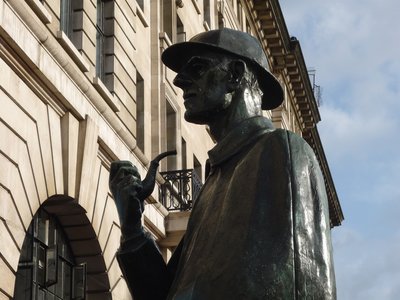
Sherlock Holmes
Marylebone Road NW1 Nearest station: Baker Street John Doubleday
A bronze in a deerstalker outside Baker Street station, unveiled in 1999. It is not the first: the same sculptor made an earlier Holmes for Meiringen in Switzerland in 1988, near the Reichenbach Falls where Conan Doyle tried to kill him off. The Baker Street figure stands at a street number the detective was given retrospectively by the council.
Rima
Hyde Park, bird sanctuary W2 Nearest station: Lancaster Gate Jacob Epstein
A stone relief in the Hyde Park bird sanctuary, showing the bird-girl from W. H. Hudson's novel Green Mansions. It caused a scandal on unveiling in 1925 and was tarred and feathered more than once in the following years. The novel is largely forgotten; the relief is still there.
Paddington Bear
Paddington Station W2 Nearest station: Paddington Marcus Cornish
On a bench on the concourse at Paddington station, suitcase beside him, at the station Michael Bond named him after. Bond bought the toy that started the books in a shop near the station on Christmas Eve; the bronze arrived much later and is now one of the most photographed objects in the building.
Peter Pan
Kensington Gardens W2 Nearest station: Lancaster Gate George Frampton
Commissioned by J. M. Barrie himself and installed overnight on May Day 1912, so that children would find it in the morning and think it had appeared by itself. It stands by the Long Water, at the spot where Peter lands in the book that preceded the play.
Winnie-the-Pooh
ZSL London Zoo, Regent's Park NW1 Nearest station: Camden Town Lorne McKean
At London Zoo, marking the real bear the character was named after: Winnipeg, a Canadian black bear brought over in 1914 and left at the zoo, where A. A. Milne's son Christopher met her. The fictional bear is world-famous; the real one is the reason the name exists.
Questions
How many statues of fictional characters are there in London?
Five are conventionally counted, and they are the five on this page. Others exist at the edges of the definition: figures from mythology, allegorical women representing virtues or rivers, characters carved as architectural decoration. But but a free-standing public statue of a named character from a specific book or story is unusual, and London has about five of them.
Is the Sherlock Holmes statue at 221b Baker Street?
It stands outside Baker Street Underground station, a short walk from the museum that carries the 221b number. That number was granted to the museum by the council instead of being the address it would otherwise have. The statue itself has no number: it is on the pavement at the junction with Marylebone Road.
Can you visit all of them in one day?
Comfortably. Four are within a mile and a half of each other along the north side of the parks (Baker Street, Paddington, Kensington Gardens and Regent's Park), and the fifth, Winnie-the-Pooh, is inside London Zoo, which charges admission. The other four are in the street or on a station concourse and cost nothing.
Why was the Peter Pan statue put up at night?
Because Barrie wanted it to seem to have arrived on its own. It was installed without ceremony overnight on 30 April 1912 and announced in The Times the next morning as a May Day surprise for the children of London. Some critics objected that Barrie had commissioned a monument to his own creation, which was true and did not stop it becoming the most visited statue in the park.
Elsewhere on this site: guide to London statues, animal statues.