London oddities: an unusual guide and map to the curiosities people pass
an unusual guide and map to the curiosities most people walk straight past
The unusual London oddities in this city are not hidden. They stand in the street, at eye level, on routes thousands of people use every day, and they go unnoticed because nothing explains them: no plaque, no label, no reason to look up. This guide collects the London oddities worth a detour, gives the street and the nearest station for each, and says plainly which of the stories attached to them are true.
An unusual guide to what is actually there
Every entry below is outdoors and free. The unusual London oddities in this list have one thing in common: each was made for a reason that has since disappeared. A brewery emblem outlived its brewery, a chimney outlived the guardroom it vented, an inscription outlived the claim it makes. What is left is the object, still in place, with its explanation gone.
That is also why the folklore is so thick around them. An unexplained object invites an explanation, and London has always been willing to supply one. Where a story is documented this guide says so; where it is invention, it says that too, because the invention is usually the more famous half.
Reading the London oddities map
The London oddities map above places each entry by postcode district rather than by street, which is enough to plan around. The pattern is the usual one for anything old in this city: the EC districts and SW1 hold most of it, because that is where the money, the government and the livery companies built. The outliers are worth the journey precisely because they are outliers.
Used as a route, the London oddities map falls into two walks. The Embankment gives you the lions, the South Bank Lion and St Bride's spire inside an hour; Soho and the Mall give you both noses in another. Nothing here needs booking and nothing closes.
The entries
The Panyer Boy
Panyer Alley EC4 Nearest station: St Paul's
A worn stone relief of a boy sitting on a bread basket, set into a wall in an alley that was once the centre of the City's bakeries. The inscription reads: When ye have sought the citty round yet this is still the highest ground.
It is wrong, because Cornhill is higher, but the stone has been in this alley since 1688 and has outlasted several of the buildings that held it.
The Embankment lions
Victoria and Albert Embankments SW1 / WC2 Nearest station: Westminster
Cast lion heads run along both river walls, each with a mooring ring in its mouth, made by Timothy Butler in 1868 for Bazalgette's embankment. The saying attached to them is that if the lions drink, London will flood. They are set at a level that made them a rough flood gauge before the Thames Barrier, which is probably how the saying started.
The South Bank Lion
Westminster Bridge, south end SE1 Nearest station: Westminster or Waterloo
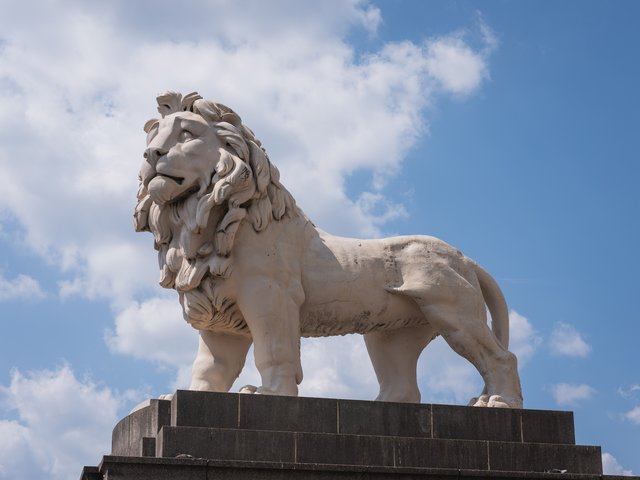
Made of Coade stone, a ceramic imitation stone whose recipe was thought lost for over a century, and originally the emblem of the Red Lion Brewery on the South Bank. When the brewery was cleared the lion was kept, and it now stands on a plinth at the end of Westminster Bridge, facing the river.
The Hyde Park pet cemetery
Victoria Lodge, Hyde Park W2 Nearest station: Lancaster Gate
A few hundred small headstones behind a lodge near Victoria Gate, begun in the 1880s with the burial of a pet terrier and closed to new burials long ago. It is not open on request: the gate is locked and the stones are read through the railings, which is the only reason most people who walk past it never notice it is there.
The chimney on Tower Bridge
Tower Bridge EC3 / SE1 Nearest station: Tower Hill
A cast-iron chimney stands on the northern approach, painted the same colour as the lamp-posts so that it reads as one of them. It vented a fireplace in a guardroom below the bridge. Millions of people cross every year and it takes a deliberate look upward to see that one of the posts is hollow.
The Berlin Wall on Royal Hospital Road
Royal Hospital Road SW3 Nearest station: Sloane Square
Three sections of the Wall, around nine tonnes, stand at the National Army Museum in Chelsea, with further pieces held at the Imperial War Museum. They came to London after 1989. A slab of painted concrete is an odd thing to find on a Chelsea side street, which is exactly why it belongs on this list.
Nelson's spare nose
Admiralty Arch, The Mall SW1 Nearest station: Charing Cross
A plaster nose protrudes from the granite inside the northern arch of Admiralty Arch. The stories are that it is a spare for Nelson in Trafalgar Square, or a tribute to Wellington, or that cavalry troopers tweaked it riding through from Horse Guards. None of them is true. It is one of Rick Buckley's casts from 1997.
The noses in Soho
Meard Street and five others W1 Nearest station: Tottenham Court Road
The same artist, the same year, and the origin of the best-known piece of London folklore in this list: that anyone who finds all seven noses comes into a fortune. Buckley installed about 35 of them as a protest against the spread of CCTV and never publicised it, so the city invented explanations instead.
The pineapples on Lambeth Bridge
Lambeth Bridge SW1 Nearest station: Westminster or Lambeth North
Stone obelisks at both ends of the 1932 bridge are topped with carved fruit that is usually called a pineapple, while the bridge’s own listing calls it a pine cone. The pineapple reading is attached to the Tradescants, the plant collectors buried in the churchyard of St Mary-at-Lambeth at the southern end of the bridge, next to Lambeth Palace. Most written versions name the younger John Tradescant rather than his father. Both men are buried there, neither attribution is documented, and the claim that a Tradescant grew the first pineapple in England is repeated everywhere and evidenced nowhere, which is the usual shape of a London story.
The Fleet under Ray Street
Ray Street EC1 Nearest station: Farringdon
London’s largest lost river runs under Farringdon Road in a sewer, and there is one place where it is still audible: a grating in the roadway outside the Coach and Horses in Ray Street. The sound is running water about four metres down. Nothing marks it and there is nothing to see, which is why a river that once carried barges is now a thing you have to stand still in a side street to notice.
The first traffic signal
Bridge Street SW1 Nearest station: Westminster
The world’s first traffic signal stood at the corner of Bridge Street and Great George Street from December 1868: a gas-lit semaphore worked by a constable, installed to get MPs across the road. It exploded within a year and injured the policeman operating it, the experiment was abandoned, and London waited until the 1920s for the next one. A plaque on the corner is all that is left of it.
Christopher Jones in Rotherhithe
St Marychurch Street SE16 Nearest station: Rotherhithe
The master of the Mayflower is buried in the churchyard of St Mary the Virgin, a few hundred metres from where the ship is thought to have been moored before the 1620 crossing. He died in 1622 and the grave is unmarked; the bronze figure of a man holding a child, looking across the river towards America, was put up in 1995. This is the London end of a story that is usually told from the other one.
The Carreras cats
Hampstead Road NW1 Nearest station: Mornington Crescent
An Art Deco cigarette factory of 1926 in the Egyptian revival style, built for a brand called Black Cat and fronted by two large cats after the goddess Bastet. The Egyptian detail was stripped off in a 1960s refit and put back in the restoration of the late 1990s, so the cats that face Mornington Crescent today are replicas of the originals rather than the originals themselves.
The garden inside St Dunstan-in-the-East
St Dunstan’s Hill EC3 Nearest station: Monument or Tower Hill
A Wren church that was left as its own ruin. The Blitz of 1941 took everything but the north and south walls and the tower and steeple Wren added between 1695 and 1701; the City of London Corporation decided in 1967 to plant the shell rather than rebuild it, and the garden opened in 1971. Trees grow through the windows, a fountain stands where the nave was, and the gate is open in the daytime with nothing at all to say what you are walking into.
The Kyoto Garden in Holland Park
Holland Park W8 Nearest station: Holland Park
A Japanese garden with a tiered waterfall, a pond of koi and, usually, peacocks, laid out in a corner of Holland Park and opened in 1991. A second Japanese garden, the Fukushima Memorial Garden, was added beside it in 2012. Neither is signposted from the road, which is why a walk through the park can miss both of them entirely.
Pickering Place
Pickering Place, St James’s Street SW1 Nearest station: Green Park
A Georgian courtyard of 1731 reached through a wood-panelled passage beside a wine merchant on St James’s Street, and often called the smallest public square in London. It is still gas-lit. The duel usually said to have been fought here is not documented; the plaque on the wall, recording that the Republic of Texas kept its legation next door until 1845, is.
St Bride's spire
Fleet Street EC4 Nearest station: St Paul's or Blackfriars
Wren's tallest spire, in three diminishing tiers, on the church of the printing and press trades. There has been a church on the site since long before Wren, and the spire is commonly said to be the model for the tiered wedding cake, a claim that is repeated far more often than it is sourced.


Questions about London oddities
What makes something a London oddity rather than a landmark?
Nothing official. The working test on this page is whether the city has left it in plain sight without explaining it. A stone boy in an alley with a wrong inscription qualifies; St Paul's does not, however strange its geometry, because it comes with a guidebook, a queue and an admission desk.
Are these free to see?
All of them, at any hour, because they are in the street. The Hyde Park pet cemetery is the exception: the enclosure is locked, and the headstones are read from outside the railings. The Berlin Wall sections stand outside the museum rather than inside it, so they do not depend on opening hours either.
How reliable are the stories attached to them?
Treat every one as folklore until it is sourced. Three of the best-known claims on this page are false: the Panyer Boy is not on the highest ground in the City, the nose in Admiralty Arch has nothing to do with Nelson or Napoleon, and the wedding-cake story about St Bride's spire is repeated much more often than it is evidenced. The entries say which is which rather than leaving it to the reader.
Which of these are on the Thames bridges?
Three. The South Bank Lion stands at the south end of Westminster Bridge, the disguised chimney is on the northern approach to Tower Bridge, and the carved pineapples top the obelisks at both ends of Lambeth Bridge. Between Westminster and Tower there are another eight road and rail crossings, and the pattern holds on most of them: the oddity is usually at the approach rather than on the span, because that is where the Victorian and inter-war engineers put the decoration.
Where are London's hidden gardens?
The two on this page are the ones that are oddities in their own right: the planted ruin of St Dunstan-in-the-East in the City, and the Kyoto Garden in Holland Park. The pattern they belong to is larger. The Phoenix Garden behind Shaftesbury Avenue is a community garden on a former car park; the Barbican Conservatory sits on top of the theatre's fly tower; and the Inner Temple and Middle Temple gardens open to the public on weekday afternoons without advertising it. All of them are free, none of them is signposted from the nearest main road, and that is the whole reason they stay quiet.
Do these disappear?
Regularly. Plaster on an outside wall does not last, brewery emblems get scrapped when the brewery goes, and street furniture is removed during roadworks and not always put back. Roughly ten of the original thirty-five noses survive. Anything on this list is here because it was still in place when the entry was written.
Elsewhere on this site: the seven noses of Soho, the guide to London statues, the London Stone on Cannon Street, the Sekhmet above Sotheby’s door, and Crossbones Graveyard in Borough.