Roman and Saxon London
what is still standing, and where to go and stand in front of it
London is about two thousand years old as a town and rather older than that as a crossing place, and almost none of it shows. The city has burned, been bombed and been rebuilt for profit so many times that its early centuries survive in perhaps a dozen places you can walk to, several of them in basements and one of them only at low tide. This page is the list, with the streets they are on and what is actually known about each.
How old the city actually is
The oldest structure anyone has found in the tidal Thames at London is a group of oak piles in the foreshore at Vauxhall, radiocarbon dated to between 1750 and 1285 BC. What it was is not settled: a bridge, a jetty and a riverside platform have all been argued, and two bronze spearheads were found driven point-down beside it, which suggests the place mattered for reasons that were not only practical. It is Middle Bronze Age, which puts a built structure on this stretch of river more than a thousand years before the Romans arrived.
Londinium itself was founded in about AD 47–50, a few years after the Claudian invasion; the earliest securely dated thing in it is a timber drain of AD 47. The name is Brittonic rather than Latin, so the Romans were rendering a British name rather than coining one, and the root behind it is still argued over and cannot be settled from what survives.
After Rome, the walled city was largely left alone. The Anglo-Saxon town was Lundenwic, a trading settlement about a mile west of the walls, spread across what is now the Strand, Covent Garden and Trafalgar Square. It lasted roughly 250 years and was given up during the Viking raids of the 880s. In 886 Alfred re-established the old walled city as a fortified burh, and London has been inside those walls, and then well beyond them, ever since.
Why so little of it shows
Three clearances did most of the damage, and the third did most of the finding. The Great Fire of 1666 took the medieval City; the Blitz took a great deal of what replaced it; and the post-war and post-1980s rebuilding took the rest. But digging foundations is also how the archaeology surfaced. The Temple of Mithras came up in 1954 out of a bomb site being cleared for an office block. The amphitheatre was found in 1988 under the site of a new art gallery. The Saxon arch at All Hallows was revealed by a bomb.
That is why the list below is mostly basements and forecourts rather than ruins in a field. Almost everything here is a fragment that a building either exposed or was built around, and the reason you can visit most of it for nothing is that the developer was required to keep it and show it.
The places
The city wall at Tower Hill
Trinity Place and Cooper's Row EC3N 4DJ
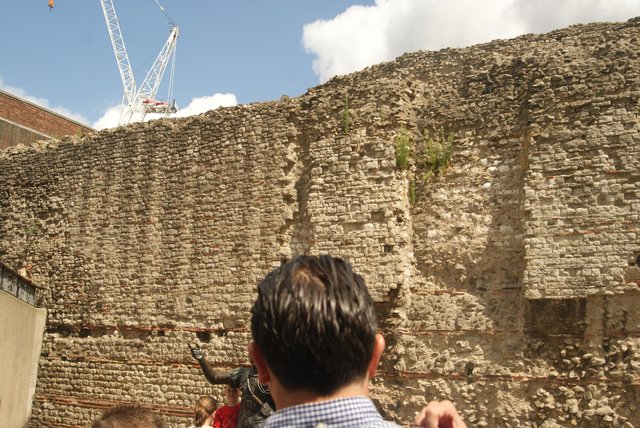
The most substantial stretch of the Roman and medieval city wall that is also easy to reach. The section at Trinity Place runs about 25 metres and stands 10.6 metres high, of which the lower 4.4 metres is Roman and the coursed stonework above it is medieval; it is in English Heritage guardianship and open in daylight, for nothing. A second stretch, arguably better preserved, stands in the forecourt of the Leonardo Royal Hotel London City on Cooper's Row, reachable from the street without going into the hotel. Nearest station Tower Hill for both. Longer runs of the wall survive at Noble Street and in the Barbican, but they are harder to read and harder to find.
The Roman amphitheatre, Guildhall Yard
Guildhall Yard EC2V 5AE
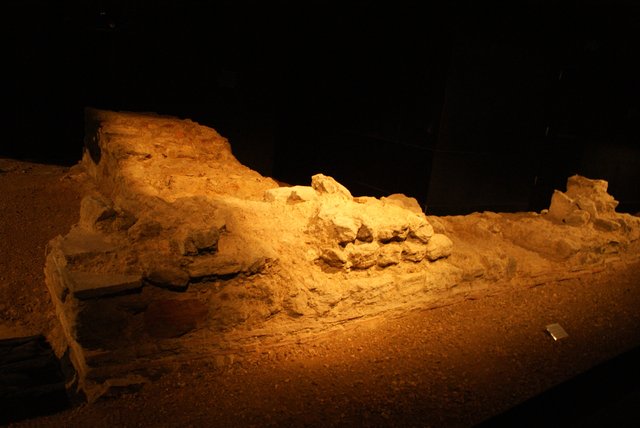
Rediscovered in 1988 during work on the new Guildhall Art Gallery, and open to the public in the gallery basement since 2002. What survives is the curved eastern entrance wall and part of the arena's drainage, lit low in a dark room with the missing tiers drawn on the walls in light. Admission is free, as is the gallery above it; the gallery does close occasionally for private events, so it is worth checking before a special journey. Nearest station Bank, about 330 metres.
London Mithraeum, Walbrook
12 Walbrook EC4N 8AA
A temple to Mithras found in September 1954 while Bucklersbury House was going up, dismantled and re-erected in 1962 on Queen Victoria Street about a hundred metres away, and in 2017 brought back to within a few metres of where it started, seven metres below the street in the basement of Bloomberg's European headquarters. It is free. Tickets are free too and booking is recommended rather than required. Closed Mondays. Nearest station Bank, a minute away.
All Hallows by the Tower
Byward Street EC3R 5BJ
The church has a Saxon arch built out of re-used Roman tile and stone, uncovered when the building was bombed in 1940. It is usually described as seventh-century, with the church's foundation, but that is a tradition rather than a date: Roman material was still being reused in London churches into the eleventh century, so the arch can only be placed somewhere across those four hundred years. The crypt below holds a late second-century Roman tessellated pavement, found in the 1920s, and is open and free. Nearest station Tower Hill.
The London Stone part folklore
111 Cannon Street EC4N 5AR
A block of oolitic limestone, 53 by 43 by 30 centimetres, set behind a grille in the wall of 111 Cannon Street and put back there in 2018 after the building was redeveloped. It is Grade II* listed and it is the surviving stump of something much larger that stood on the south side of the street. The name is first recorded around 1100. A Roman origin is plausible and unproven, and what it was for is not known. The story that it is the altar stone of Brutus of Troy, and the line about London standing only so long as the Stone of Brutus is safe, were written by Richard Williams Morgan in 1862 — nineteenth-century invention, not ancient prophecy. Nearest station Cannon Street, directly opposite.
The Vauxhall foreshore timbers
Thames foreshore by Vauxhall Bridge SW8
About twenty-two oak piles running some eighteen metres out into the river near the mouth of the Effra, dated to 1750–1285 BC and eroding. Only a few of them are exposed, and only at the lowest tides, which makes this the one entry here that cannot be visited on a whim: it needs a tide table and it needs care, because the Thames foreshore is dangerous and the tide comes in faster than people expect. A separate and much older group of piles, from around 4790–4490 BC, was found upstream at the MI6 site; the two are not the same structure. Nearest station Vauxhall.
Lundenwic, under the Strand
Aldwych and the Strand WC2B
There is nothing to see, and that is worth saying plainly rather than sending anybody to look. The Anglo-Saxon trading town lay under what is now the Strand, Covent Garden and Trafalgar Square, and it is known from excavation rather than from anything standing. Its name survives in Aldwych, from Old English for the old settlement, recorded as Aldewich in 1211 — though the street called Aldwych was only laid out in 1905, so the name is old and the road is not. Nearest station Covent Garden or Temple.
Questions
What is the oldest thing in London you can actually see?
The Bronze Age piles in the Thames foreshore at Vauxhall, at the lowest tides. Above ground and available at any hour, it is the Roman city wall at Tower Hill, whose lower courses were built around AD 200.
How much of Roman London can be visited for nothing?
Most of it. The wall at Tower Hill and Cooper's Row is outdoors and free, the amphitheatre under Guildhall Art Gallery is free, the London Mithraeum is free, and the Roman pavement in the crypt at All Hallows by the Tower is free. Four sites, no admission charge between them.
Was Winchester the capital of Anglo-Saxon England?
Anglo-Saxon England had no capital in the modern sense; the king's court moved constantly. Winchester was the principal royal centre of Wessex and held the treasury, while London was the largest and richest town. Government settled at Westminster under Edward the Confessor and stayed there after 1066.
Why was a Roman amphitheatre only found in 1988?
Because nobody had dug deep enough in the right place. It sits about six metres below Guildhall Yard, and the excavation that found it was the one preparing the ground for a new art gallery. Most of Roman London has been located this way, as a condition of somebody else's building work.
Is there anything left of Lundenwic?
Nothing above ground. It is known from excavation under the Strand, Covent Garden and Trafalgar Square, and from the place-name Aldwych, which means the old settlement. The modern street of that name dates only from 1905.
Elsewhere on this site: guide to London statues, London oddities, strange museums.