London casinos' secret treasures
the listed rooms, the art and the histories behind the gaming floors
London's gaming rooms occupy some of the most interesting buildings in the city, and the buildings are the part worth writing about. A Grade I listed townhouse by William Kent, a Frank Matcham theatre of 1900, a Victorian hotel ballroom: the rooms came first and the tables arrived later. What follows is about the architecture, the art and the histories attached to the casinos in London, rather than about the games played in them.
Rooms that were something else first
Almost none of these interiors was built for gaming. Britain only licensed casinos after the Betting and Gaming Act of 1960, so every historic room now used for it was converted from something earlier: a private house, a theatre, a hotel function suite. That is why the ceilings are better than the carpets.
It also means the listed status usually attaches to the building rather than to the business inside it. 44 Berkeley Square is Grade I listed for its staircase, which is one of the finest of the 1740s in London, and it was that long before anybody put a roulette wheel under it.
The places
44 Berkeley Square
44 Berkeley Square W1
A townhouse of 1742-44 by William Kent, Grade I listed, with a staircase that is one of the most admired domestic interiors of its date in England. John Aspinall opened the Clermont Club in it in 1962, the year after the law changed, and its early membership famously included five dukes and two cabinet ministers. The house has since changed hands more than once. It is the building, not the club, that is the treasure.
The Hippodrome
Cranbourn Street, Leicester Square WC2
Built in 1900 to designs by Frank Matcham, the architect of the London Coliseum and the Blackpool Tower Ballroom, and originally a circus and variety house with a water tank under the arena for aquatic spectacles. It has been a theatre, a nightclub and a casino, and Matcham's auditorium is still legible inside it. Free entry, open around the clock.
The Ritz Club closed
150 Piccadilly W1
In the basement of the Ritz Hotel, in what had been the hotel's ballroom, decorated in a Louis XVI manner with painted ceilings. It held a collection of 17th and 18th-century paintings and was, for a time, the most opulent gaming room in London. It closed permanently in May 2020 and has not reopened. The hotel above it is Grade II* listed and still very much there.
Crockford's
50 St James's Street SW1
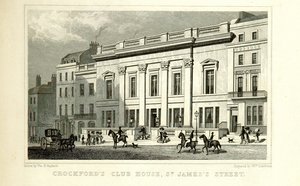
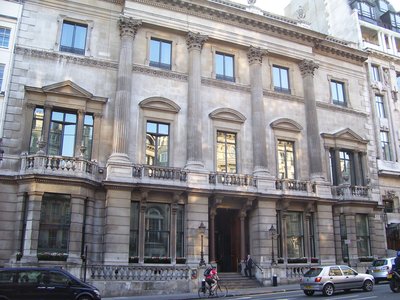
The original Crockford's opened on St James's Street in 1828, built by a fishmonger turned gambling-house proprietor who made a fortune from the aristocracy and lost much of it again. Thomas Hosmer Shepherd engraved the club house for his Metropolitan Improvements in the same decade. The building later became the Devonshire Club and still stands; the name has since been used by a separate casino elsewhere in Mayfair.
The art, and where to see it for free
Tate Britain, Millbank SW1
Private clubs are private, and what hangs in them cannot be checked from the pavement. What can be checked is that the modern British painters most often mentioned in connection with Mayfair collections are very well represented in public ones a few minutes' walk away. Work by David Hockney and Bridget Riley is held by Tate, which charges nothing for its permanent collection. That is a better afternoon than trying to talk your way into a members' room.
Questions
Can you look inside these buildings without gambling?
The Hippodrome has free entry and no membership requirement, so the Matcham auditorium can be seen by anyone who walks in. The Mayfair clubs are private and the answer there is no. 44 Berkeley Square is occasionally opened for architectural events, which is the realistic way to see the staircase.
Why are so many London casinos in listed buildings?
Because casinos were only licensed in Britain from 1960 and had to move into whatever suitable premises existed. In central London that meant grand houses, theatres and hotels, most of which were already old and many of which have since been listed. The gaming licence is recent; the buildings are not.
Is the Clermont Club the oldest casino in London?
No. It opened in 1962, immediately after the law permitting casinos changed. The much older name is Crockford's, whose original club house opened on St James's Street in 1828, decades before licensed casino gaming existed in any modern sense.
What happened to the Ritz Club?
It closed permanently in May 2020 during the first Covid lockdown and did not reopen; staff were made redundant and outstanding player balances became a matter of public reporting. The Ritz Hotel itself continues to operate. Any guide still listing the Ritz Club as somewhere to visit is out of date.
Elsewhere on this site: guide to London statues, London oddities.