Lost stations
the disused Underground stations still standing, and the ones you can get inside
About forty London Underground stations have closed, and a surprising number are still standing in plain sight. The trick is knowing what to look for: most of the Edwardian ones were built to one architect's pattern, in a dark red glazed terracotta that has weathered better than anything around it, so a disused station tends to be the handsomest building on its block. Nine of them here, with what is actually left, and which ones will let you in.
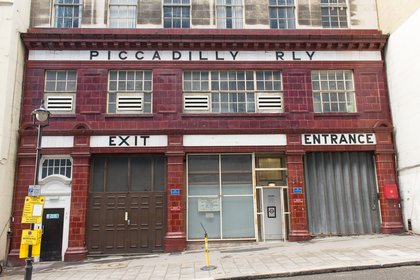
How to spot one
Leslie Green designed the surface buildings for the three tube railways that became the Piccadilly, Northern and Bakerloo lines, and he worked to a pattern: two storeys, a steel frame, and a skin of oxblood glazed terracotta with wide semicircular windows on the first floor. The colour is the giveaway. It was chosen to be legible through smoke and it does not fade, so a hundred and twenty years later these buildings still read as a set.
Once a station closed, the frontage usually survived because it was structurally sound and commercially useful. What went was the inside. So the thing to look for is a Green frontage with its entrance bays bricked up or turned into a shop, which is exactly what you see at Down Street, at Brompton Road's surviving elevation, and at South Kentish Town.
Two things the guides get wrong
Down Street was not a deep-level shelter. It was something more interesting. From early 1939 it was fitted out as the bomb-proof headquarters of the Railway Executive Committee, with the platform faces bricked up and offices, meeting rooms, dormitories, bathrooms, a telephone exchange and a two-person lift put into the shafts. Churchill and the war cabinet used it as a stop-gap until the Cabinet War Rooms were ready, and he called it The Barn. It was never one of the eight purpose-built deep-level shelters of the 1940s.
The Kingsway tram subway was not built to relieve traffic. The London County Council needed to link its northern and southern tram networks so that northern cars could reach the repair depot at Charlton, and the Holborn and Kingsway slum clearance handed it a route. It is the only tram subway ever built in Britain. Congestion relief belongs to the Strand Underpass, which came later and reused the southern end of it.
Which ones will let you in
One, reliably: Aldwych, where the London Transport Museum has run tours since 2016 and is booking months ahead. Down Street and the Kingsway tunnel are both on the museum's list with no dates on sale at the time of writing, so watch for a release instead of turning up. Brompton Road is not on the programme at all.
Two others are open by a side door. The old station at South Kentish Town now holds escape rooms, themed on John Betjeman's story about a passenger who got off there by mistake and could not get out again, which is the most appropriate reuse on this page. And the Crystal Palace subway, restored and reopened in 2024, holds public open days.
The entries
Aldwych, formerly Strand
Surrey Street WC2R 2ND Nearest station: Temple Leslie Green
The one everybody has seen without knowing it. Opened as Strand on the 30th of November 1907, renamed Aldwych on the 9th of May 1915 once Charing Cross stopped being called Strand, and closed on the 30th of September 1994 because replacing the 1907 lifts would have cost three million pounds on a station losing a hundred and fifty thousand a year. Grade II listed since July 2011. It has stood in for the working Underground in Superman IV, Patriot Games, V for Vendetta, Atonement, 28 Weeks Later, Mr Selfridge and Sherlock, among many others, which is why the platforms look familiar. London Transport Museum runs eighty-minute tours from the Surrey Street entrance, currently booking into 2027, including a family version. King's College uses the offices upstairs.
Down Street
Down Street W1J 7JU Nearest station: Hyde Park Corner Leslie Green
Opened on the 15th of March 1907 and closed on the 21st of May 1932, squeezed to death between Hyde Park Corner five hundred metres one way and Dover Street, now Green Park, five hundred and fifty the other, both being rebuilt with escalators at the time. Then it had the best second life of any station on this list: the Railway Executive Committee's bomb-proof headquarters from 1939, and Churchill's shelter before the Cabinet War Rooms opened. The oxblood frontage is still on Down Street with part of the ground floor let as a shop and the old entrance bays plainly blocked. It is not listed, which surprises people. Tours run from the Athenaeum Hotel when the museum puts dates on sale.
Brompton Road
Cottage Place SW3 2BQ Nearest station: Knightsbridge Leslie Green
Opened on the 15th of December 1906 and closed on the 30th of July 1934, and the very day Knightsbridge opened a new southern entrance a few hundred metres away, which is a tidier explanation than the usual one about being too close to its neighbours. Just before the war the War Office bought the surface building, the lift shafts and the lower passages for twenty-two thousand pounds and made it the anti-aircraft operations room for central London. Then the modern part: the Ministry of Defence sold it in March 2014 for fifty-three million pounds to the Ukrainian businessman Dmytro Firtash, the flats that justified the price were never built, the site was reported seized for creditor banks in 2022, and Firtash was sanctioned by the United Kingdom in November 2024. The Brompton Road frontage went in 1972; what survives is the Cottage Place elevation, oxblood terracotta with a blocked doorway still numbered 206. Not listed, and not open.
Hyde Park Corner's first entrance
11 Knightsbridge SW1X 7LY Nearest station: Hyde Park Corner Leslie Green
Not a lost station so much as a lost door. When escalators and a new sub-surface ticket hall opened on the 23rd of May 1932, the original surface building became redundant and its lift shafts were turned over to ventilation, which is what they still do. A pizza restaurant occupied it until June 2010, and since December 2012 it has been a hotel. The building is not listed. While you are here: the Underground's first escalators ran at Earl's Court from the 4th of October 1911, which is what made this kind of rebuilding possible in the first place.
Mark Lane
16 Byward Street EC3R 5BA Nearest station: Tower Hill
Opened on the 6th of October 1884, renamed Tower Hill on the 1st of September 1946, and closed on the 4th of February 1967 because the crowds had outgrown a site with nowhere to expand into. The present Tower Hill replaced it, on the site of a station that had closed in 1884, so the two swapped places across eighty years. The surface station had been rebuilt in 1911 inside an office block on Byward Street. Below the pavement the old overbridge survives as a subway with big white grilles over the stairways down to the platforms, but it is closed to general access and opened only for events, so it is something to look down into rather than walk through. One platform is still visible from trains between Monument and Tower Hill, on the right going east. Not listed.
The Kingsway tram subway
Southampton Row at Theobalds Road WC1B 4AE Nearest station: Holborn
Opened on the 24th of February 1906, with through running from April 1908, rebuilt for double-deck trams in 1929 to 1931, and finished on Saturday the 5th of April 1952 when routes 33 and 35 ran for the last time. Trams reached the Embankment but never crossed Waterloo Bridge, because permission was refused and a curve had to be cut out through the bridge's west wall instead. The southern end is now the Strand Underpass, open to cars since January 1964, and the old south portal under the bridge has been a bar, then a club, then a theatre, and went on the property market in May 2026. What to go and see is the northern ramp, still gated, on Southampton Row at the Theobalds Road crossroads, and the northern section is Grade II listed and Camden stores masonry down there.
South Kentish Town
141-145 Kentish Town Road NW1 8PR Nearest station: Kentish Town Leslie Green
Opened on the 22nd of June 1907 and closed on the 5th of June 1924, when a power failure at Lots Road shut it temporarily and nobody could find a good reason to reopen it. It sheltered people in the war and now serves the Northern line as permanent-way access and an emergency exit. The Green frontage survives in retail use on Kentish Town Road, and the old station holds escape rooms built around John Betjeman's story of a passenger who got off here by mistake and could not get out which makes this the only lost station on the list you can pay to be locked inside. Not listed.
The Crystal Palace subway
Crystal Palace Parade SE19 1LG Nearest station: Crystal Palace
The most beautiful thing on this page and not a Tube station at all. Built in 1865 to carry passengers from the High Level station under the Parade and straight into the Palace, in Italianate brick and stone with fan vaulting that photographs like a cathedral crypt. The Palace burned in 1936, the station closed in 1954 and was demolished, and the subway simply stayed. Grade II* listed since 1972, which is a higher grade than anything else here. It reopened in September 2024 after a restoration costing three and a half million pounds and now holds public open days, including a slot on the Open House programme. Directly opposite the working station.
Euston's surviving entrance
Melton Street NW1 Nearest station: Euston Leslie Green
Included because it is the exception that corrects a story. Euston had two tube surface buildings of 1907, one of them Green's on Drummond Street and Melton Street, and both closed on the 30th of September 1914, not because of escalators, which Euston did not get until the 1960s, but because a single new entrance inside the main-line station replaced the pair of them. The Melton Street building survived as an electrical substation. It is not listed, it stands inside the HS2 site, and it is slated for demolition, so this is the one entry here with a deadline on it.
Questions
Which lost Underground stations can you actually get inside?
Aldwych, reliably: London Transport Museum has run tours there since 2016 and books months ahead. Down Street and the Kingsway tram tunnel are both on the museum's programme but had no dates on sale when this was written, so watch for a release. South Kentish Town is open in a roundabout way, as escape rooms, and the Crystal Palace subway holds public open days. Brompton Road is on no programme at all.
How do you recognise a disused station from the street?
Look for dark red glazed terracotta and wide semicircular windows on the first floor. Leslie Green designed the surface buildings for three tube railways to one pattern, and the colour was chosen to stay legible through coal smoke, so it has barely faded in a century. Then look at the ground floor: a Green frontage with its entrance bays bricked up or turned into a shop is almost always a closed station.
Was Down Street one of the deep-level shelters?
No, and it is a better story than that. From 1939 it was the bomb-proof headquarters of the Railway Executive Committee, fitted with offices, dormitories, bathrooms and a telephone exchange behind bricked-up platform faces. Churchill and the war cabinet used it until the Cabinet War Rooms were ready; he called it The Barn. The eight purpose-built deep-level shelters were a separate programme.
Why was the Kingsway tram subway built?
To join up the London County Council's tram networks. The northern and southern systems did not connect, which meant northern cars could not reach the repair depot at Charlton, and the Holborn slum clearance provided a route. It is the only tram subway ever built in Britain. The idea that it was London's first attempt at easing traffic belongs to the Strand Underpass, which was cut into its southern end in 1964.
Are these buildings listed?
Some, and fewer than people assume. Aldwych is Grade II, listed in July 2011. The northern section of the Kingsway subway is Grade II, listed in February 1998. The Crystal Palace subway is Grade II*, listed in 1972 and the highest grade here. But Brompton Road, Down Street, Mark Lane, South Kentish Town, the Euston building and 11 Knightsbridge have no listing at all.
What happened to Brompton Road station?
It was sold. The Ministry of Defence put it on the market in 2013 expecting about twenty million pounds and sold it in March 2014 for fifty-three million to the Ukrainian businessman Dmytro Firtash. The flats that justified the price were never built, the site was reported seized for creditor banks in 2022, and Firtash was sanctioned by the United Kingdom in November 2024. The surviving frontage on Cottage Place has been shut the whole time.
Elsewhere on this site: London oddities, post boxes and how to date them.