London statues: an unusual guide and map to the city's public sculpture
an unusual guide to the sculpture the city walks past every day, with a map of where it stands
Nobody has ever counted the sculpture in this city, and no single body keeps a register of it. This guide lists unusual London statues alongside the famous ones, the way you would want them listed while standing in the street: the subject, the sculptor where the attribution is solid, the street it stands in and the station to get out at. They are treated exactly alike, because the fifth-best equestrian general is of less interest than a cat on a plinth in a courtyard off Fleet Street.
How this guide to London statues is organised
By subject, not by sculptor and not by borough. Somebody looking for the animals wants them together whether they stand in Bloomsbury or Bermondsey, and somebody who has just walked past a charity-school figure in a painted coat wants the other forty, not a list of everything within a mile. Each subject sheet carries its own entries with street and station; this page is the way in and the index over the top of them.
The unusual London statues are not filed separately. Setting them apart would suggest the rest are ordinary, and the interesting thing about the city's sculpture is that the strangest pieces are usually a few doors from the most conventional ones. A guide that hides that is less useful than one that does not.
Reading the London statues map
The London statues map below is a density diagram rather than a route. Each circle sits roughly where its postcode district sits and is sized by how many catalogued entries that district holds, with the same numbers set out in the table underneath for anyone who would rather read them than judge circles by eye. Positions are schematic: a postcode map of central London is a diagram, and pretending it is a survey would be the wrong kind of precision.
What the map shows is unsurprising once you see it. Sculpture follows money, government and livery companies, so the counts pile up in SW1 around Whitehall and the parks, and again in the EC districts around the City churches and the halls. It thins fast going west and south. The current count across the districts shown is 47 entries.
Used the other way round, the London statues map answers the question most people arrive with: not where one particular figure stands, but what is worth an hour on foot from wherever they happen to be. Pick the district, open the subject sheets it appears on, and the walk assembles itself.
| District | Entries |
|---|---|
| SW1 | 10 |
| EC4 | 6 |
| EC3 | 4 |
| NW1 | 3 |
| SW7 | 3 |
| EC2 | 3 |
| E1 | 3 |
| WC2 | 3 |
| W8 | 2 |
| SE1 | 2 |
| WC1 | 2 |
| EC1 | 2 |
| W2 | 1 |
| W6 | 1 |
| W14 | 1 |
| SE16 | 1 |
The unusual ones, and where they stand
A selection, each checked against a second source before it went on the page. Every one of them is free to look at, outdoors, at any hour.
| Subject | What it is | Street | Nearest station |
|---|---|---|---|
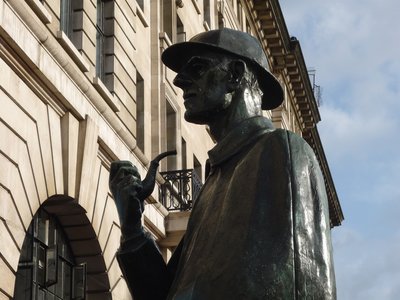
| Sherlock Holmes | A detective who never existed, in bronze outside the station that carries his address. | Marylebone Road NW1 | Baker Street |
| Peter Pan | Placed overnight in 1912 so that children would think it had appeared by itself. | Kensington Gardens W2 | Lancaster Gate |
| Paddington Bear | On a bench on the concourse, at the station the bear is named after. | Paddington Station W2 | Paddington |
| The Window Cleaner | Allan Sly's cleaner, looking up at more windows than anyone would want to start on. | Chapel Street NW1 | Edgware Road |
| The Gardener | Karin Jonzen's kneeling figure, in a garden built on a bombed churchyard. | Brewers Hall Garden EC2 | Barbican |
| Hodge | Samuel Johnson's cat, on a plinth outside the house where the dictionary was written. | Gough Square EC4 | Chancery Lane |
| Physical Energy | G. F. Watts spent decades on this rider and never quite finished with him. | Kensington Gardens W2 | South Kensington |
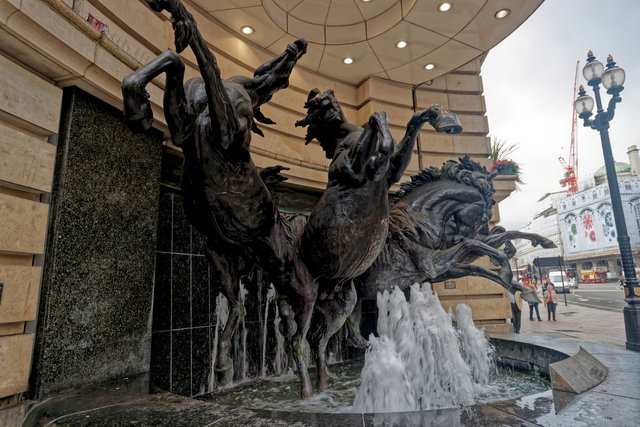
| The Quadriga | Peace descending on the chariot of war, on top of the arch in the middle of the traffic. | Hyde Park Corner SW1 | Hyde Park Corner |
| The Guards Memorial | Five guardsmen cast from guns captured in the First World War. | Horse Guards Parade SW1 | Charing Cross |
| The Greencoat Boy | A charity-school figure in his eighteenth-century uniform, still on the street the school stood on. | Greencoat Place SW1 | St James's Park |
Sculpture by theme
The recurring subjects, each with its own sheet of entries.
-
Statues of fictional characters
Sherlock Holmes, Peter Pan, Paddington Bear and the rest of the people who never lived.
-
Workers
Cleaners, gardeners, cordwainers and commuters, in a city that mostly commemorates generals.
-
Animals
Lions, a cart horse, a cat with an oyster, and a flock of sheep in Bloomsbury.
-
Horses
From the Quadriga at Hyde Park Corner to the oldest bronze statue in London.
-
Bluecoat and greencoat figures
Charity-school children in painted uniform, still standing above their old doorways.
-
War memorials
The Embankment run, from the Anglo-Belgian memorial to the Battle of Britain.
-
Heraldry and building arms
Coats of arms on livery halls, insurance offices and the Stock Exchange.
Sculpture by place
Where it is worth walking with your head up, park by park and street by street.
-
Kensington Gardens
Peter Pan, Physical Energy, the Albert Memorial animals and the Elfin Oak.
-
Kensington Gardens, continued
The rest of the park, including Queen Anne's Alcove and the Italian Gardens.
-
Hyde Park
Achilles, the Serpentine, and the memorials that arrived late.
-
Horse Guards Parade
The Guards Memorial, the Cadiz Memorial and an Ottoman gun.
-
Piccadilly Circus
Anteros rather than Eros, the Three Graces on the roof, and a listed police post.
-
Bond Street
An Egyptian goddess over a saleroom door, a Moore, and the only carillon in London.
-
Wapping
River stairs, Execution Dock, and the churches of the sea captains.
-
The Remembrancer's office
The one office in the City with a seat in Parliament, and the figures above it.
Objects in the street
The furniture nobody photographs: the datable, the listed and the misexplained.
-
Post boxes
How to date one from the cipher, and the eight in London that are listed.
-
Street furniture
Vulliamy's sphinxes and camels, cattle troughs, real cannon and a sewer gas lamp.
-
Drinking fountains
What the Metropolitan Drinking Fountain Association left on the streets.
-
Ships in unexpected places
Weathervanes, emblems and reliefs, and the truth about the Mall lampposts.
-
London oddities
The South Bank Lion, the Panyer Boy and the things that fit no other category.
-
The Thames bridges
Eight central crossings, the eight bronzes on Vauxhall Bridge, and which of them is the Ladies' Bridge.
-
The seven noses of Soho
Rick Buckley's protest against surveillance cameras, and where the noses are.
Questions about London statues
How many London statues are there?
Nobody has a definitive figure. The city has never kept a single register: works are commissioned by boroughs, churches, livery companies, private landlords and the Royal Parks, and some are listed while others are not. Counting sculpture on buildings as well as free-standing figures pushes any estimate into the thousands.
Which are the oldest?
The bronze equestrian Charles I at the top of Whitehall dates from 1633, which makes it the oldest bronze statue in London still standing outdoors. Older stone figures survive on churches and gatehouses, though most have been recut or replaced at least once.
Are the addresses on this page exact?
Each entry gives the street and postcode district it stands in, plus the nearest station, which is enough to find it on foot. Sculpture does move: works get taken away for conservation, buildings are redeveloped and plinths are occasionally emptied for good. Where an entry is known to have moved, it says where it went.
Why are some entries buildings rather than figures?
Because a great deal of the city's sculpture is architectural. A coat of arms over a livery-hall door or a relief on an insurance office is carved by the same people, in the same decades, as the free-standing statues a few streets away, and leaving it out would give a false picture of what London actually put up.