Animal statues
in London: lions, a cart horse, a cat with an oyster and a flock of sheep
London has more animals in stone and bronze than it has generals, once you count the ones on buildings. Some are heraldic, some are memorials, and a few are portraits of specific creatures that actually lived: a cat, a cart horse, a bear at the zoo. This sheet covers the free-standing ones, with the street and the nearest station for each.
Heraldic beasts and real ones
The distinction worth drawing is between an animal used as a symbol and an animal commemorated as itself. A lion on a gatepost is a symbol; the lion at the end of Westminster Bridge began as a brewery's trade mark and ended up a monument to itself. Hodge, outside Dr Johnson's house, is a portrait of one specific cat that somebody remembered fondly enough to write down.
The real ones are rarer and better company. They also date the sculpture precisely: an animal commemorated as an individual belongs to a period when that seemed a reasonable thing to spend money on.
The entries
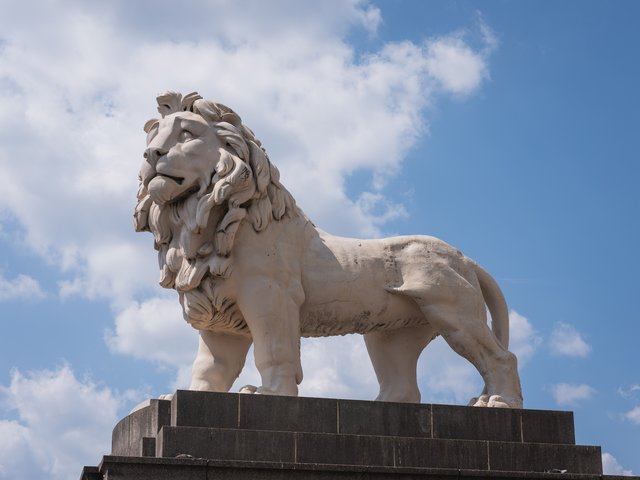
The South Bank Lion
Westminster Bridge, south end SE1 Nearest station: Westminster
Coade stone, an artificial stone whose recipe was lost for over a century, and originally the emblem of the Red Lion Brewery on the South Bank. When the brewery was cleared the lion was kept and eventually placed at the end of Westminster Bridge, where it now faces the river.
Hodge
Gough Square EC4 Nearest station: Chancery Lane
Samuel Johnson's cat, in bronze on a plinth outside the house in Gough Square where the dictionary was compiled, with a pair of oyster shells at his feet. Oysters were cheap food in the eighteenth century and Johnson is recorded as fetching them himself so as not to trouble the servants on the cat's behalf.
Jacob the cart horse
Queen Elizabeth Street SE1 Nearest station: London Bridge
A life-size dray horse near the south end of Tower Bridge, lifted into place by helicopter, marking the brewery that stood on the site and the horses that worked it. It is one of the few pieces of public sculpture in London that had to be delivered by air.
The Albert Memorial animals
Kensington Gardens SW7 Nearest station: South Kensington
Look at the four corner groups, not at the gilded prince. Each represents a continent through an animal: a bull for Europe, a camel for Africa, an elephant for Asia and a bison for the Americas. They are the most-photographed animals in London that nobody photographs on purpose.
Lioness and Kudu
Upper Grosvenor Gardens SW1 Nearest station: Victoria
A lioness bringing down a kudu, in a small garden behind Victoria station, commissioned privately and unusually violent for a London square. It is the only piece on this sheet that depicts an animal doing what animals do.
The dogs at Belgrave Square
Belgrave Square SW1 Nearest station: Hyde Park Corner Jonathan Wylder
Two dogs sit at the feet of Robert Grosvenor, 1st Marquess of Westminster, who holds a set of architectural plans: this is the square his family developed. The plinth carries a line from Ruskin, when we build let us think that we build for ever, which is either a fair claim for Belgravia or a very large one. The dogs are the reason to stop. They are patient in a way that suggests the sculptor had watched dogs wait for somebody to finish working.
The Russell Square sheep
Russell Square WC1 Nearest station: Russell Square Sir Richard Westmacott
At the base of the Duke of Bedford's monument, a group of sheep and a ploughing scene, representing agriculture and the family's land. A flock of sheep in the middle of Bloomsbury is exactly the kind of thing that goes unnoticed for a lifetime of walking past.
The Hammersmith bull
243 King Street W6 Nearest station: Ravenscourt Park
A bull above a shopfront on King Street, left from a butcher's or a cattle market and now simply part of the building. Architectural animals like this one outnumber the free-standing statues many times over and are almost never recorded.
Questions
What is Coade stone?
A ceramic imitation stone made in Lambeth from the 1770s, fired, not carved, and much more weather-resistant than most natural stone. The works closed in the 1830s and the exact recipe was not recorded, which is why the material is often described as a lost secret. Surviving Coade stone pieces around London are noticeably crisper than limestone of the same age.
Are the Albert Memorial animals separate sculptures?
They are parts of four large marble groups, one at each outer corner of the memorial, each representing a continent with a human figure group and a large animal. They were carved by different sculptors and are worth treating as four works, not as decoration on a fifth.
Is Hodge a real cat?
Yes. Hodge belonged to Samuel Johnson and appears in Boswell's Life, which is why a specific eighteenth-century cat has a bronze and thousands of others do not. The oyster shells refer to Boswell's account of Johnson buying oysters for him personally instead of sending a servant.
Where is the best short walk for these?
Gough Square to the Embankment covers Hodge and the lion heads on the river wall in about twenty minutes, and Westminster Bridge adds the South Bank Lion. Kensington Gardens is a separate trip and rewards it: the Albert Memorial groups, Physical Energy and Peter Pan are all within a few hundred metres.
Elsewhere on this site: guide to London statues, horses in London sculpture.