Statues of workers
in London: the cleaners, gardeners and traders a city of generals put up anyway
Most of the figures standing in London commemorate men who commanded something. A much smaller set commemorates the people who did the work, and they are scattered across the City and the fringes of the West End, not gathered in any square. They are also, almost without exception, recent: the idea of putting up a bronze of an anonymous worker belongs to the last seventy years.
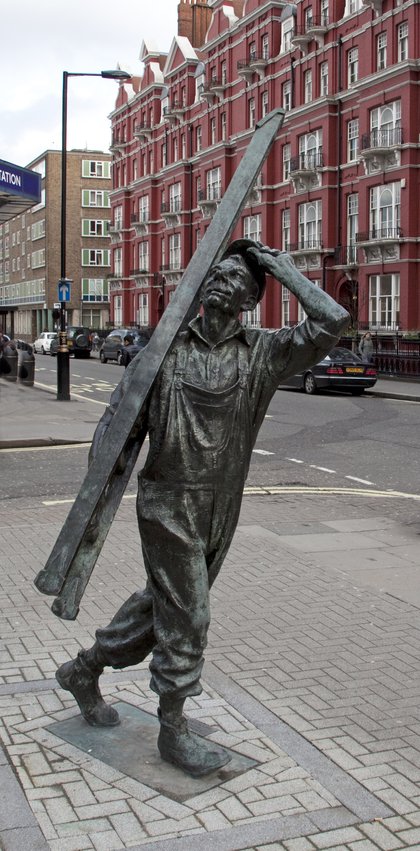
Where the working figures are
Overwhelmingly in the City and on its edges, because that is where the commissioning happened. A developer finishing an office block in the 1980s or 1990s wanted something in the forecourt, and a figure of a worker was both cheaper than an abstract and less likely to be laughed at than a statue of the chairman.
The result is a category of public sculpture that maps the last two generations of City redevelopment, not the history of London labour. The trades represented are the ones that happened to have a building going up nearby.
The entries
The Window Cleaner
Chapel Street NW1 Nearest station: Edgware Road Allan Sly
A cleaner with his bucket, looking up at the windows of Capital House, and one of the earliest public works by a sculptor who went on to make large pieces for cruise liners. It is life-size and set at pavement level, so it reads as a man who has stopped to consider the size of the job.
The Cordwainer
Watling Street EC4 Nearest station: Mansion House
A shoemaker at his last, outside St Mary Aldermary, marking a ward named after the leather-workers who once filled it. Cordwainer Ward still exists as a City ward, which makes the figure a piece of administrative history as much as a statue.
The Gardener
Brewers' Hall Garden EC2 Nearest station: Moorgate Karin Jonzen
A kneeling figure planting, in a small garden laid out on ground cleared by bombing. The sculptor also made the pair of figures nearby in the Barbican; this one is the quieter of her City works and the easier to walk past.
Rush Hour
Broadgate EC2 Nearest station: Liverpool Street
A bronze group of commuters at Broadgate, walking in step and not looking at each other. It is one of a set of public works commissioned when the estate was built over the old Broad Street station, and it is the most literal treatment of office work anywhere in the City.
The Building Worker
Tower Hill EC3 Nearest station: Tower Hill Alan Wilson
A three-metre bronze at Tower Hill, raised as a memorial to construction workers killed at work. It is the only figure in this group that exists to commemorate deaths, not to decorate a development, and it is used as the focus of an annual gathering.
The LIFFE Trader
Walbrook EC4 Nearest station: Cannon Street Stephen Melton
A floor trader in a coloured jacket, mobile phone raised, opposite Cannon Street station. It was cast in 1997, two years before open-outcry trading on the London futures exchange effectively ended, so it commemorates a job that had almost finished by the time the bronze cooled.
Questions
Are these memorials or decoration?
Mostly decoration, with one clear exception. The Building Worker at Tower Hill is a memorial to people killed in construction and is treated as one. The others were commissioned as part of building schemes, which does not make them less interesting, but it does explain why they cluster where the cranes were.
Why are there so few of them?
Because public statuary in Britain was, for most of its history, a way of arguing that a particular individual mattered. An anonymous worker makes the opposite argument. Figures like these only start appearing in numbers after the Second World War, and most of the London examples are from the 1980s onwards.
Is the LIFFE Trader still relevant?
As a record, very. Open-outcry pit trading in London ended within a couple of years of the statue being made, and the jacket, the pit hand signals and the handset it depicts all vanished from the City. It is now a monument to a working method rather than to a current job, which is unusual for a bronze that recent.
Which of these is easiest to find?
Rush Hour, because Broadgate is a pedestrian estate with signage and the group stands in the open. The Cordwainer and the Gardener are both tucked against buildings and need the street name, not a general direction. The Window Cleaner is on a side street off the Edgware Road and is the one most people miss.
Elsewhere on this site: guide to London statues, heraldry on London buildings.