Heraldry on London buildings
the coats of arms on livery halls, insurance offices and railway termini
Heraldry is the most widespread sculpture in London and the least looked at. Almost every institutional building of any age carries arms somewhere on its front, and they are readable: a coat of arms states who paid for the building and what they claimed about themselves. This sheet takes seven that are worth stopping for, with the street and the nearest station.
How to read a building's arms
Start with whose they are. Corporate arms belong to a company, a livery company, a city or a college, and they are granted, not invented, which means somebody recorded what each element is supposed to mean. The animals and objects are not decoration: they are a claim about trade, origin or patronage.
Then look at where they sit. Arms over a main entrance are a statement of ownership; arms repeated along a frieze are usually the places a company traded with, which turns the front of a building into a map of its business.
The entries
The London Stock Exchange arms
Paternoster Square EC4 Nearest station: St Paul's
On the exchange building at Paternoster Square, with the motto dictum meum pactum, my word is my bond, which was the working principle of a market run on verbal agreement. The motto outlasted the trading floor it described.
Trinity House
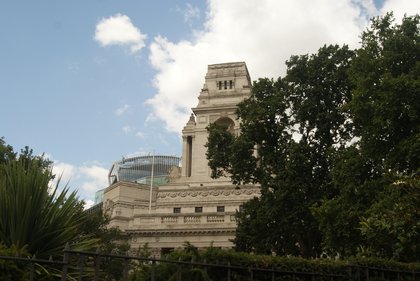
Trinity Square EC3 Nearest station: Tower Hill
The arms of the corporation responsible for lighthouses and pilotage, on its eighteenth-century headquarters near Tower Hill, with ships and a cross. Trinity House still maintains the lights, which makes these working arms, not historical ones.
The Chartered Insurance Institute
20 Aldermanbury EC2 Nearest station: Moorgate
Arms on the hall at Aldermanbury, along with a museum of firemarks, the metal plaques householders fixed to their walls to show which insurer would send an engine if the building caught fire. The arms and the firemarks tell the same story from two directions.
The Huddersfield arms on the Strand
200 Strand WC2 Nearest station: Temple
A northern town's arms on a London office front, put up by a company that wanted its origin on the building. Provincial civic arms in central London are usually a sign of a business that made its money elsewhere and moved its head office south.
The Belfast arms at the Adelphi
Adelphi, John Adam Street WC2 Nearest station: Embankment
Belfast's arms (a seahorse, a chained wolf and a ship) on a building off the Strand. The seahorse and ship are for the port; the wolf is older and less explained, which is normal for the animal in a civic coat of arms.
Goodenough College
Mecklenburgh Square WC1 Nearest station: Russell Square
Arms over the entrance of a residential college for postgraduate students from overseas, on a Bloomsbury square. Twentieth-century institutional heraldry is often the most legible, because it was designed when the conventions were being taught rather than assumed.
The Chatham Railway arms at Blackfriars
Blackfriars Bridge, north bank EC4 Nearest station: Blackfriars
The arms of the London, Chatham and Dover Railway on the old bridge abutment at Blackfriars, kept when the bridge itself was dismantled. Nearby, the station wall carries the carved destination names the railway served, from Margate to St Petersburg.
Questions
Are these coats of arms official?
Corporate and civic arms in England and Wales are granted by the College of Arms and are legally the property of the body they were granted to, so the ones on this sheet are official in a way that a company logo is not. Whether a particular carving is an accurate rendering of the grant is a separate question, and some are not.
What is a firemark?
A small metal plaque fixed to the front of an insured building, showing the insurer's badge and often a policy number. Before municipal fire brigades, insurers ran their own engines and the mark told a crew whether the building was their responsibility. Several hundred survive in situ around Britain and a good collection is held at Aldermanbury.
Why do London buildings carry other cities' arms?
Because the company that built them came from somewhere else and wanted that on the front. Insurance, railway and shipping companies in particular used civic arms to claim a place of origin or a network of trade, which is why a Strand office front can carry a Yorkshire town's arms.
Is there a register of London's heraldry?
Not a complete one. The College of Arms records grants, not the buildings they end up on, and no single survey covers the carvings themselves. Individual buildings are documented in listing descriptions, which is the most reliable place to check what a particular set of arms is and when it went up.
Elsewhere on this site: guide to London statues, London oddities.