Bluecoat figures
in London: the charity-school children still standing above their old doorways
Small painted figures of children in long coats stand above doorways across London, usually in pairs, a boy and a girl. They marked charity schools, and the colour of the coat was the school's identity: blue, green, grey or brown. Most of the schools are gone and a surprising number of the figures are still in place, on buildings now used for something else entirely.
What the coats meant
A charity school clothed its pupils, and the uniform doubled as advertising for the subscribers who paid for it. Blue was much the commonest, so 'bluecoat' became the general term, but greencoat, greycoat and browncoat schools all existed and several London street names still carry the colour.
The figures themselves are usually Coade stone or painted wood and are repainted periodically, which is why they look newer than they are. They are among the few pieces of London street sculpture that are meant to be brightly coloured rather than weathered.
The entries
Christ Church Blewcoat
Caxton Street SW1 Nearest station: St James's Park
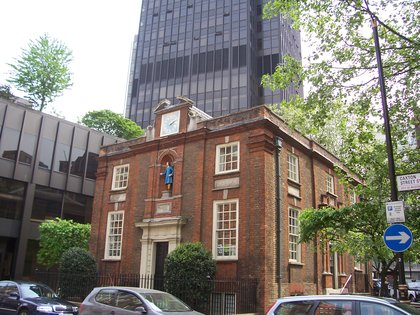
A boy in a blue coat above the door of the former Blewcoat School, a small brick building of 1709 that survived the redevelopment of everything around it. The school taught local children for over two centuries; the building has since been a shop and an office.
The Greencoat Boy
Greencoat Place SW1 Nearest station: St James's Park
A figure in green above what was the Greencoat school, on the street that still carries the name. Greencoat Place, Greycoat Place and Brewers Green are all within a few hundred metres, which makes this corner of Westminster the densest concentration of charity-school naming in London.
Greycoat Hospital
Greycoat Place SW1 Nearest station: St James's Park
A pair of figures, boy and girl, above the entrance of a school founded in 1698 that is still a school today. The building was bombed in 1941 and the figures survived; they were restored along with the front.
St Mary Rotherhithe
St Marychurch Street SE16 Nearest station: Rotherhithe
Two figures on the front of the old charity school beside the church, in a corner of Rotherhithe that also holds the church where the master of the Mayflower is buried. The school building is eighteenth-century and now in other use.
St John's Old School, Wapping
Scandrett Street E1 Nearest station: Wapping
A boy and a girl on the front of the former parish school, a short walk from the river. Wapping keeps more of this kind of thing than its size suggests, because so little of it was rebuilt after the docks closed.
Raine's School
Raine Street E1 Nearest station: Wapping
Figures above the door of a school founded by a local brewer in the 1720s. The building is early Georgian and the inscription over the entrance is still legible from the pavement.
St Andrew's, Holborn
St Andrew Street EC4 Nearest station: Chancery Lane
A pair of figures now set on the tower of the church, not on a school building, having been moved when their school was demolished. Displaced figures like these are common: when the school goes, the parish keeps the children.
Sir John Cass Primary
Duke's Place EC3 Nearest station: Aldgate
A boy in red, not blue, marking a school endowed in the early eighteenth century. The figure is a copy; the original is kept indoors, which is the usual fate of any of these that becomes valuable enough to steal.
Hatton Garden
Hatton Garden EC1 Nearest station: Farringdon
Two figures on the front of a former charity school in the jewellery quarter, above a doorway on a street now given over entirely to the trade. The building is easy to miss between shopfronts.
St Mary Abbots, Kensington
Kensington Church Street W8 Nearest station: High Street Kensington
A boy and girl on the old school building near the church, at the top of Kensington Church Street. The pair are painted and maintained, and they are the westernmost of the figures on this sheet.
Questions
What was a bluecoat school?
A charity school, funded by subscription, that clothed and taught poor children. The best known is Christ's Hospital, founded in London in 1552 and still using a blue coat as its uniform, though the school itself moved to Sussex in 1902. Hundreds of smaller parish versions existed across the city.
Why are the figures painted?
Because they are advertisements as much as sculpture. A subscriber walking past needed to see at a glance which school this was and that it was still going, and the coat colour did that work. They have been repainted repeatedly, which is why several look considerably newer than their buildings.
Are any of the schools still operating?
Greycoat Hospital and Sir John Cass are both still schools, though not in the form their founders would recognise. Most of the others closed or amalgamated during the nineteenth and twentieth centuries, leaving the figure on a building that has since been a warehouse, a shop or a flat.
How many survive in London?
Several dozen, and the number is not fixed: figures are stolen, moved indoors for safety, or rediscovered when a building is cleaned. Ten of the more findable ones are listed above, weighted towards Westminster and Wapping because that is where the survival rate is highest.
Elsewhere on this site: guide to London statues, statues of workers.