War memorials
on the Embankment and at Hyde Park Corner, in the order you meet them
The Victoria Embankment carries more war memorials per hundred metres than anywhere else in Britain, and almost nobody walks it as a sequence. This sheet takes them in order, adds the Hyde Park Corner group at the other end of the route, and gives the street and station for each. The whole thing is about an hour on foot and costs nothing.
Why they are all in one place
Partly because the Embankment was new ground. Bazalgette's river wall created a long stretch of public frontage in the 1870s with no existing claims on it, exactly when the demand for memorial space was about to become enormous. Partly because it is on the route between Westminster and the City, which is where processions go.
The result is a chronological accident, not a plan: memorials from the 1920s stand beside ones from the 2000s, at similar scale, addressing wars seventy years apart. Read west to east it is a fairly complete record of how Britain changed its mind about how to commemorate.
The entries
The Guards Memorial
Horse Guards Parade SW1 Nearest station: Charing Cross Gilbert Ledward
Five guardsmen in greatcoats facing the parade ground, cast from guns captured during the First World War. The figures are deliberately undramatic, men standing at ease rather than charging, which was unusual for 1926 and has aged much better than the alternative.
The Royal Air Force Memorial
Victoria Embankment SW1 Nearest station: Embankment
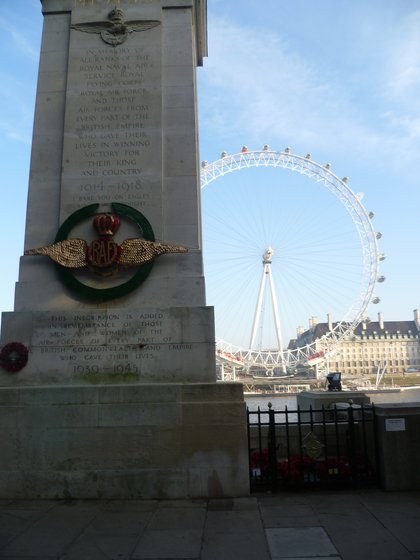
A gilded eagle on a globe on a tall pylon at the river wall, put up in 1923 for the service that was five years old at the time. It faces the river rather than the road, so most people see the back of it.
The Battle of Britain Monument
Victoria Embankment SW1 Nearest station: Westminster Paul Day
A long bronze frieze set into the river wall, unveiled in 2005, showing aircrew scrambling and civilians sheltering, with the names of the aircrew who flew in the battle cast around it. It is the newest major memorial on the Embankment and the one people spend longest reading.
The Anglo-Belgian Memorial
Victoria Embankment WC2 Nearest station: Temple
A gift from Belgium in gratitude for Britain taking in refugees during the First World War, with a group of figures above a low wall. Its subject is hospitality and not combat, which makes it the odd one out along this stretch.
The London Troops Memorial
Royal Exchange, Bank EC3 Nearest station: Bank
Outside the Royal Exchange, with two soldiers flanking a column, commemorating the London regiments. It is the City's own memorial, not a national one, and the regimental badges around the base are worth a slow look.
The Euston railway memorial
Euston Station forecourt NW1 Nearest station: Euston
A tall obelisk-like memorial outside Euston station to the London and North Western Railway employees killed in the First World War, with figures of servicemen at the corners. Railway companies built their own memorials, and this is the largest surviving London example.
The Cavalry Memorial
Hyde Park W1 Nearest station: Hyde Park Corner Adrian Jones
St George on foot, standing over a dragon, with the horse behind him: a cavalry memorial in which the rider has dismounted. It was moved within Hyde Park in the 1960s and now stands near the bandstand.
Achilles
Hyde Park, Park Lane corner W1 Nearest station: Hyde Park Corner Sir Richard Westmacott
The Wellington Monument at Hyde Park Corner: a colossal bronze nude, cast from captured French cannon and paid for by public subscription from the women of Britain in 1822. Its nudity caused a long argument and a fig leaf, which was removed and replaced more than once.
Questions
Can these be walked in one route?
Yes. Hyde Park Corner to Bank, along Constitution Hill, through Horse Guards and then east along the Embankment, takes about an hour at a normal pace and passes every memorial on this sheet except the Euston one, which needs a separate short trip.
Which is the oldest?
Achilles, from 1822, though it commemorates Wellington's victories rather than a war in the modern memorial sense. Of the memorials built to remember the dead rather than to honour a commander, the railway and regimental ones of the early 1920s are the earliest here.
Why are so many made from captured guns?
Melted enemy ordnance was both cheap bronze and a deliberate statement, and the practice runs from Achilles in 1822 through to the Guards Memorial a century later. It also means the metal in several of these objects was made for the opposite purpose.
Are wreaths laid at all of them?
At most, on the relevant anniversaries, not only in November. The Guards Memorial, the London Troops Memorial and the Battle of Britain Monument all have their own services, and the Belgian memorial is used for commemorations connected to the refugee history it records.
Elsewhere on this site: guide to London statues, horses in London sculpture.