London post boxes
how to date one from the cipher, and the ones that are listed buildings
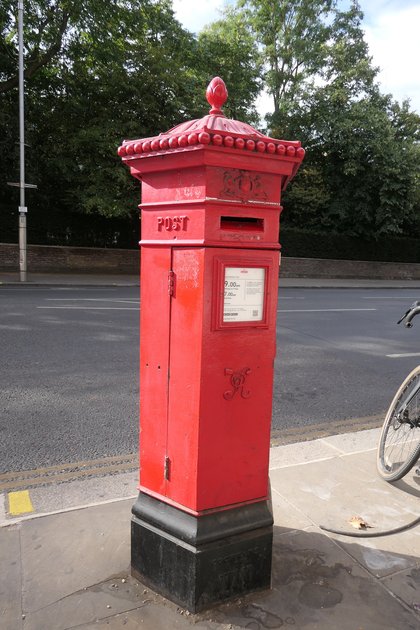
A post box is the most precisely datable object on a British street. The monarch's cipher on the door narrows it to a reign, the shape narrows it further, and a few carry a plaque telling you outright. There are about 115,000 of them in the United Kingdom, Royal Mail said in August 2025, within half a mile of 98 per cent of addresses, so this is a guide you can use on the way to the shops. Eight London boxes are listed buildings in their own right.
Where they came from, and when they turned red
The first four British pillar boxes went into use in St Helier on the 23rd of November 1852, with Guernsey following in February 1853. Jersey is a Crown Dependency and not part of the United Kingdom, which is why the date usually given is 1853, the mainland debut at Botchergate in Carlisle. Anthony Trollope is credited with the idea and the credit is too generous: he recommended them as a surveyor's clerk, George Creswell, Surveyor of the Western District, placed the order, and John Vaudin of St Helier cast them.
They were not always red and they were never crimson. No standard colour existed until 1859, when bronze green became the rule. Red arrived in 1874, in London first, that July, and repainting the fleet took about ten years, so for a decade the country had both.
Reading the cipher
The cipher is the door's date stamp, and the proportions are documented. Royal Mail and Historic England put more than 60 per cent of British boxes on Elizabeth II's EIIR or a Scottish crown, about 15 per cent on George V, and then, in descending order, smaller numbers from George VI, Victoria and Edward VII. That last is the rarest of the named reigns, so an ER VII door is a find. Note the Scottish exception: boxes there carry the Crown of St Andrew and no cipher at all, which is why the 60 per cent figure bundles two different things.
The words matter too, because the trade uses them precisely. A pillar box stands free on the pavement. A wall box is set into masonry. A lamp box is strapped to a post, a type introduced in 1896 for London squares. Letter box is the umbrella term for all of them, which is why the society that records them is the Letter Box Study Group, while Royal Mail's own word is post box.
Five things everybody says that are wrong
That two slots mean the box postdates 1968. Dual-aperture boxes date from 1899, when the pair split London and Abroad from Country so the Post Office could pre-sort. First and second class began on the 16th of September 1968 and the existing boxes were simply relabelled. Two slots put a box after 1899.
That Edward VIII's boxes were smashed after the abdication. That happened, but to different boxes: the hammers, tar and two improvised explosive devices were aimed at EIIR boxes in Scotland in 1952 and 1953. After Edward's abdication wall-box doors were swapped for George VI ones and Ludlow enamel plates were changed, while the pillar-box doors were left alone, which is exactly why almost every surviving Edward VIII box is a pillar box.
That the VR cipher first appeared on the Penfold. It is on the Channel Island boxes of the 1850s and on an 1861 Scottish wall box, and the listing entries for London's Penfolds describe VR sitting beside the Royal Arms.
That the 1980 cylindrical box is the 1978 National Standard. Three errors in one sentence. The Post Office ran a three-designer competition, installation began in 1980, and National Standard is the name of the improved design of 1859.
That the boxes were rebranded ROYAL MAIL in 1991. The change came in the early 1990s, prompted by the separation of Post Office Counters from Royal Mail, and the boxes carrying it were made from about 1994. Give it a range.
The entries
The Anonymous box, Thurloe Place
Corner of Thurloe Place and Thurloe Square SW7 Nearest station: South Kensington Andrew Handyside & Co, Derby
A cylindrical box carrying the maker's name and no royal cipher at all, which is why collectors call the type Anonymous. Andrew Handyside of Derby cast them, and the survey record dates this one 1883 to 1887, the half of the period after the aperture was lowered, because letters had been getting caught under the rim. POST OFFICE and the cipher came back in 1887. It is not listed. It is also not on Brompton Road, where every guide puts it: that comes from one mislabelled archive record whose own address field reads Thurloe Square. Royal Mail's reference for it is SW7 22.
The box with two slots, Royal Hospital Chelsea
London Gate, Royal Hospital Road SW3 4SR Nearest station: Sloane Square
A Victorian box in the railings with an aperture on each side, so you can see straight through it. It sits at London Gate, and the explanation everybody gives is that the second slot lets the Chelsea Pensioners post from inside the walls when the gates are shut for the night. That is a good explanation and it has exactly one published source, a Londonist social post of February 2026, with nothing from the Royal Hospital, Royal Mail or Historic England, so treat it as the received account, not the record. The box itself is not listed; it is covered only by the listing of the gates it stands in. Reference SW3 16, cipher VR.
The Penfold, Cornwall Gardens
Adjacent to Cornwall House, Cornwall Gardens SW7 4AB Nearest station: Gloucester Road John Wornham Penfold
The famous one: hexagonal, fluted, with a foliated cap, designed in 1866 by John Wornham Penfold, a surveyor and architect and a founding member of the Institution of Surveyors. There are thirteen variants. The Letter Box Study Group's directory counts 138 originals still standing and 82 replicas, not the 150 and 100 usually quoted. This one is Grade II listed and the entry describes VR insignia beside the Royal Coat of Arms, which is the evidence against the claim that VR debuted on the Penfold. Note the postcode: this is SW7, not the W8 the guides give it.
The Penfold, Tunis Road
Outside No 49, Tunis Road W12 7HN Nearest station: Shepherd's Bush Market John Wornham Penfold
West London's listed Penfold, and a useful second opinion on the cipher question: Historic England's entry reads simply Penfold pillar box. 1872 type. Hexagonal pattern with VR monogram. Grade II. Worth the trip out if you want to see one away from the museum quarter, where almost every guide sends you.
The Penfold, Devonshire Road
Corner of Benson Road, Devonshire Road SE23 3LZ Nearest station: Forest Hill John Wornham Penfold
South-east London's, and the listing is the most descriptive of the three: circa 1859-1879, cast iron hexagonal Penfold design, with foliated ogee top and knob finial. Grade II. The date range is wider than the others because the entry hedges, not because the box is unusual.
The Brixton pillar box, Mervan Road
Mervan Road, Brixton SW2 Nearest station: Brixton
Grade II, and the entry is terse: pillar box, 1872, cast iron, hexagonal with acorn finial. Its statutory address carries no postcode, and its grid reference falls in SW2, not the SW9 you might assume from Brixton, so this is one to find by street name.
The type K, Prince Consort Road
Prince Consort Road SW7 2BB Nearest station: South Kensington Tony Gibbs
The modern one, and the plaque on it settles an argument: One of the first castings of the 1980 'K' pillar box. Tony Gibbs designed it after a three-designer competition, and the cipher is recessed to give a perfect cylindrical outline, which with the one-piece body, the lifting ring and the flanged base is what lets these be rolled and craned instead of carried. Note what the plaque does not say: it says one of the first, not the first. Which type K went in first is not recorded anywhere, and the story that it was outside the Royal Albert Hall in 1979 comes from a single self-contradicting blog. It is behind the Hall, and it is 1980.
133 Fleet Street, and what is not at Ludgate Circus
133 Fleet Street EC4A 2BB Nearest station: City Thameslink
London's first pillar boxes were not one but six, opened to the public on the 11th of April 1855: Fleet Street, the Strand, Pall Mall, Piccadilly, Grosvenor Place and Rutland Gate. They were rectangular Grissell boxes with ball finials, and not one survives: photographs, a few parts, and the preserved example destroyed by a bomb in the Blitz. So there is nothing to see at the Fleet Street and Farringdon Street corner. What is worth walking to instead is the double-aperture VR box outside Peterborough Court, a few hundred metres west, reference EC4 409, which carries a plaque for Trollope's bicentenary.
A Charles III box
Eltham Post Office, 33 Court Yard SE9 5DB Nearest station: Eltham
The cipher is a C, the Roman numeral III and an R for Rex under a Tudor Crown, written CIIIR, not the CR III you will see online, which reverses it. Scotland keeps the Crown of St Andrew instead. The first one was unveiled on the 12th of July 2024 at Great Cambourne in Cambridgeshire, and its cipher was left gold to mark it as the first; the ones that followed have it painted red. That Cambridgeshire box is the only one with unimpeachable sourcing. In London the one to try is the solar parcel postbox outside Eltham Post Office, evidenced by a local magazine and a surveyed map record, not by Royal Mail, so go with modest expectations. Do not trust any national total for Charles III boxes: Royal Mail has published none.
Questions
How do I tell how old a post box is?
Read the cipher on the door. Royal Mail and Historic England put more than 60 per cent of British boxes on Elizabeth II's EIIR or a Scottish crown, about 15 per cent on George V, and then descending numbers from George VI, Victoria and Edward VII. An ER VII door is the rarest of those. Shape narrows it further, and a handful carry a plaque that simply tells you.
When did post boxes turn red?
1874, in London first, that July. Before 1859 there was no standard colour at all; from 1859 it was bronze green. Repainting the whole fleet took about ten years, so for a decade both colours were on the streets. Nothing in the record says crimson.
Did Anthony Trollope invent the pillar box?
No. He recommended them, as a surveyor's clerk, and that is a real contribution but a smaller one than the story gives him. George Creswell, Surveyor of the Western District, placed the order, and John Vaudin of St Helier cast the first four, which went into use in Jersey in November 1852.
Why is there no V in George V's cipher?
Because he chose it that way. The Postal Museum holds the submitted designs, which show the V present and then dropped in favour of something simpler and bolder for Post Office use. He was the fifth George but the first to have roadside letter boxes in his name, so there was nothing to distinguish it from.
Does a box with two slots date from 1968?
No, and this is the easiest of these to disprove in the street. Dual-aperture boxes date from 1899 and the pair originally split London and Abroad from Country, for pre-sorting. First and second class began on the 16th of September 1968 and the existing boxes were relabelled. Two slots mean after 1899.
What happened to Edward VIII's post boxes?
Less than the story claims. His 326-day reign produced 271 letter boxes: 161 pillar boxes, six wall boxes and 104 Ludlows, and the Letter Box Study Group counts 171 survivors in Britain. After the abdication wall-box doors were replaced with George VI ones and Ludlow plates were changed, but the pillar-box doors were left alone, which is why nearly every survivor is a pillar box. The hammers and tar belong to the EIIR boxes in Scotland in 1952 and 1953, a different fight.
Elsewhere on this site: London oddities, guide to London statues.