Kensington Gardens, part two
Peter Pan, a carved oak stump, an explorer's obelisk and two embracing bears
The northern half of Kensington Gardens has the park's best-known statue and its least-known ones. Peter Pan draws a queue; a few hundred metres away an obelisk to the man who found Lake Victoria, a carved tree stump full of elves and a temperance memorial in the shape of two bears get almost no attention at all.
What a park collects
None of this was planned as a collection. A park next to a palace accumulates: an author pays for a statue of his own character, a geographical society puts up an obelisk, a temperance body marks an anniversary with a drinking fountain, and a medical statue is shunted here from Trafalgar Square because it was unpopular there.
That last one is worth knowing. Edward Jenner's statue was the first erected in Kensington Gardens and it arrived because Trafalgar Square did not want it. Objections were raised to a doctor standing among admirals.
The entries
Peter Pan
The Long Water W2 Nearest station: Lancaster Gate
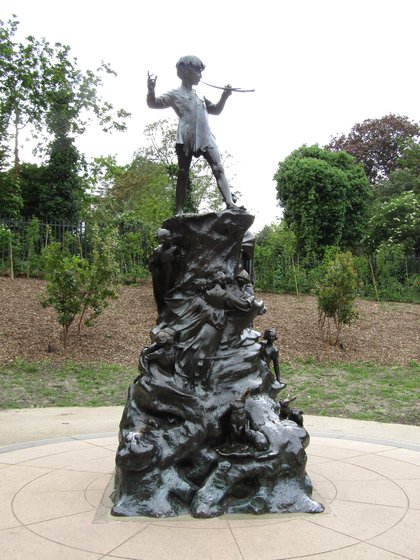
Commissioned by J. M. Barrie and installed overnight on May Day 1912 so that children would think it had appeared by itself. Questions were asked in the press about an author being allowed to erect a monument to his own creation. It stands by the Long Water at the spot where Peter lands in the book.
The Elfin Oak
Near the Diana Memorial Playground W2 Nearest station: Queensway
A nine-hundred-year-old oak stump brought from Richmond Park and carved with elves, fairies and small animals by Ivor Innes between 1928 and 1930. Grade II listed, restored more than once, and now under a protective cage. Loved and loathed in roughly equal measure since it arrived.
The Speke monument
Lancaster Walk W2 Nearest station: Lancaster Gate
A granite obelisk to John Hanning Speke, the first European to see Lake Victoria, in 1862. He died in a shooting accident in 1864, the day before he was due to debate his rival Richard Burton about the source of the Nile. Whether the shooting was an accident has been argued about ever since.
Edward Jenner
Italian Gardens W2 Nearest station: Lancaster Gate
The pioneer of smallpox vaccination, seated, by William Calder Marshall. Erected in Trafalgar Square in 1858 and moved here in 1862 after objections to a physician standing among military figures. It was the first statue in the gardens.
Queen Anne's Alcove
North end of the Long Water W2 Nearest station: Lancaster Gate
A garden building of 1705, moved here from the south of the palace so that the queen could look down her own gardens. Long attributed to Wren and now more usually given to William Kent, which is the sort of question that stays open.
The Two Bears fountain
Italian Gardens W2 Nearest station: Lancaster Gate
Two bears embracing, put up in 1939 for the eightieth anniversary of the Metropolitan Drinking Fountain and Cattle Trough Association, which built free drinking fountains across London to promote temperance by providing an alternative to beer.
Questions
Why was Peter Pan put up at night?
Barrie wanted it to seem to have arrived on its own, and it was installed without ceremony overnight on 30 April 1912, then announced in the press the next morning as a May Day surprise. The criticism that an author had commissioned a monument to his own creation was fair and made no difference.
Can you touch the Elfin Oak?
No. It has been vandalised and weathered repeatedly and now stands behind a protective cage, which makes photographing it awkward and looking at it perfectly possible. It has been restored several times, once with the involvement of the comedian Spike Milligan, who campaigned for it.
Was Speke's death an accident?
The inquest said so: a self-inflicted gunshot while climbing a wall with a loaded gun, the day before his debate with Burton. The timing has kept the alternative suggestion alive for a century and a half without anybody producing evidence for it.
Why is Edward Jenner in a park?
Because Trafalgar Square objected. His statue stood there from 1858 and was moved here in 1862 after complaints that a doctor did not belong among admirals and generals. Punch published a satirical verse about the removal at the time.
Elsewhere on this site: the first half of Kensington Gardens, statues of fictional characters.