Bond Street
a lion-headed goddess over a saleroom door, a Moore on a terrace, and the only carillon in London
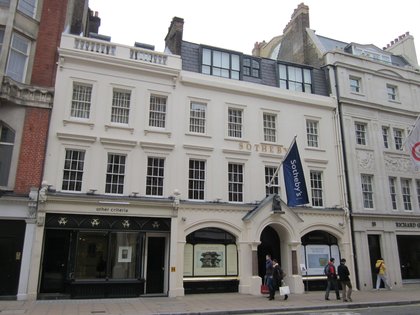
Bond Street is a shopping street where nobody looks up, which is a pity, because almost everything worth seeing on it is above the shopfronts. A three-thousand-year-old Egyptian goddess sits over a saleroom door. A Henry Moore screen stands on a terrace above a bank. There are twenty-three bells in a tower on the corner of Burlington Gardens, the only carillon in London, and most people who walk under them have no idea they are there. Eight things, all of them free, all of them visible from the pavement.
Objects that were never meant to be public art
Almost none of this was commissioned to be looked at by passers-by. The Sekhmet is an unclaimed auction lot. The Moore screen was a client's commission for the front of an office building. The carillon was a perfumer's advertisement. The blue plaque at 103 marks six weeks of a naval officer's life. What they have in common is that they are all on buildings, not on plinths, which on this street is the same as being invisible.
The street is named after Sir Thomas Bond, who developed it in the 1680s. That is the whole of his involvement; he carved nothing and paid for none of this.
Two claims this page used to make and no longer does
The Sekhmet is very often called London's oldest outdoor sculpture, and this page said so. It is not true. Cleopatra's Needle on the Victoria Embankment is roughly 1450 BC and stands outdoors in public. The defensible version is narrower and more interesting: the oldest outdoor antiquity in London still in private hands.
The story that the Sekhmet was sold in the 1880s for forty pounds and never collected is repeated everywhere and sourced nowhere. Sotheby's own account puts it in Giovanni Belzoni's sale of June 1822 and says openly that the accounts conflict: some hold that it sold and was never collected, others that it found no buyer and was abandoned by the consignor. Bruce Chatwin pointed out in the 1960s that it does not appear in the Belzoni catalogue at all. Nobody knows how it got over the door.
The entries
The Sekhmet at Sotheby's
34-35 New Bond Street W1A 2AA Nearest station: Bond Street
A figure of the lion-headed Egyptian goddess Sekhmet in a hard black stone, which Sotheby's describes as diorite, fixed above the New Bond Street entrance. It is of about 1320 BC, Eighteenth Dynasty, and is probably one of the six hundred or so Sekhmets that stood in the Temple of Mut at Karnak. The firm moved here from Wellington Street in 1917 and she has been over the door since. How she arrived is genuinely unknown; the confident version you will read elsewhere is not sourced.
The Atkinsons carillon
24 Old Bond Street W1S 4AL Nearest station: Green Park
Twenty-three bells, two octaves less the two lowest semitones, in the tower on the corner of Burlington Gardens. They were cast by Gillett and Johnston, mostly in 1925, installed in 1927 and 1928, with one cracked bell replaced in 1932, and they are the only carillon in London, one of about fifteen in the British Isles. They are played by hand from a baton clavier, the batons struck with the fists and the pedals with the feet; an older electropneumatic keyboard with pinned barrels survives but is disconnected. Recitals are currently suspended for building work, so any timetable you find online is out of date. The building is of 1926 by Vincent Harris, Grade II, and its list description mentions the bells. Atkinsons the perfumer, here since 1832, has gone; the shop below is Ferragamo's London flagship, still trading under that name when the building changed hands in December 2024.
Henry Moore's Time-Life screen
153 New Bond Street W1S Nearest station: Bond Street
A Portland stone screen of 1952 and 1953 on the terrace of the former Time-Life building, designed to be read from the street and from the terrace at once. Moore wanted the carved blocks mounted so they could be turned, which was not done. Four abstract pieces, cut in his own garden, and there is a Draped Reclining Figure by him inside. His own complaint about the commission is the useful thing to know before you look: he thought the terrace was too high for the screen to be seen properly, and asked to buy the pieces back.
Allies
New Bond Street at Grafton Street W1S 3SX Nearest station: Green Park
A bronze of Roosevelt and Churchill sitting on a bench with a gap between them, which is there to be sat in, and is the most photographed thing on the street. Lawrence Holofcener finished it in 1990 at his own expense; the Bond Street Association then bought it and gave it to the City of Westminster, and Princess Margaret unveiled it on the 2nd of May 1995. The plaque records that it marks fifty years of peace. The aside that the two men were distant cousins is worth stating properly or not at all: genealogical work published by the International Churchill Society makes them seventh cousins.
103 New Bond Street
103 New Bond Street W1S 1ST Nearest station: Bond Street
A mid-eighteenth-century stuccoed brick house of four storeys and three bays, Grade II, with a London County Council blue plaque of 1958: Horatio, Lord Nelson, 1758 to 1805, lived here in 1798. The tenancy was short: he took the rooms in early February and left on the 16th of March, about six weeks, but Historic England notes that this is the only one of Nelson's London residences still recognisable as a Georgian house. Everything else he lived in has gone or been refronted.
The Royal Arcade
28 Old Bond Street to 12 Albemarle Street W1S 4BT Nearest station: Green Park
A glazed passage of curved-bay shopfronts, Ionic columns and heavily modelled stucco arches under a saddle roof, running from Old Bond Street through to Albemarle Street. It opened in 1880, when the Illustrated London News announced it in April as the new arcade in Bond Street, and it was simply The Arcade until the shirtmaker H. W. Brettell won Queen Victoria's patronage and it became Royal. Grade II, though the listing dates the fabric to about 1890, a decade later than the opening. No architect can be attributed to it: Historic England names none, and the name that circulates online rests on a citation that does not support it.
The Fine Art Society building
148 New Bond Street W1S 2TR Nearest station: Bond Street
A Portland stone front of 1876 by E. W. Godwin in a Transitional Gothic free style, Grade II, containing one of the very few purpose-built late-Victorian gallery interiors left in London. The Fine Art Society was founded in 1876, pioneered the idea of the one-man exhibition, and showed Whistler's Venice etchings here in December 1880 and again in 1883, the second show hung by Whistler himself as an arrangement in white and yellow. The society left in 2018 after about a hundred and forty-two years and now trades from Edinburgh; the building has been Halcyon Gallery's flagship since 2023. Go for Godwin's front, not for the society.
Conduit Street
Conduit Street W1S Nearest station: Oxford Circus
The name is the oldest thing here and it is about water, not shopping. Conduit Mead was a twenty-seven-acre field held by the City of London, crossed by the lead main that carried water from the springs of the Tyburn to the Great Conduit in Cheapside — a run begun in the 1240s by way of Charing Cross, the Strand, Fleet Street and Ludgate. Two things usually said about it are wrong: the pipe was lead rather than wood, and the springs were not where Bond Street station stands but a few hundred metres east, around what is now Stratford Place on the north side of Oxford Street. The City held the field from the fifteenth century and leased it out; the streets on it were laid over the water course.
Questions
Is the Sekhmet really London's oldest outdoor statue?
No. Cleopatra's Needle on the Victoria Embankment is about 1450 BC and stands outdoors in public, which makes it older by more than a century. The claim that survives scrutiny is narrower: the Sekhmet is the oldest outdoor antiquity in London still in private hands.
How did it end up above a saleroom door?
Nobody knows. Sotheby's says it is believed to have been offered in June 1822 as part of Giovanni Belzoni's collection, and that the accounts disagree about what happened next: some say it sold and was never collected, others that it found no buyer at all. Bruce Chatwin noted that it does not appear in the Belzoni catalogue. The version with a date and a price attached is not sourced.
Can you see the Henry Moore from the street?
Yes, and that was the point of it: the screen was cut to be read from the pavement and from the terrace at the same time. Moore himself thought the terrace was too high for it to work and asked to buy the pieces back, so judge for yourself.
When can you hear the carillon?
Not at the moment. Recitals are suspended while building work goes on, and the Friday-evening and Saturday-afternoon times still circulating online are out of date. When it does play it is played by hand, on special occasions, from a baton clavier inside the tower.
Is the Fine Art Society still on Bond Street?
No. It sold the lease and left in 2018 after roughly a hundred and forty-two years, and now trades from Dundas Street in Edinburgh, where it marks its hundred and fiftieth year in 2026. Godwin's 1876 front is still at 148 New Bond Street, with Halcyon Gallery behind it.
Who was Bond Street named after?
Sir Thomas Bond, who developed the street in the 1680s. He is not connected to anything else on this page.
Elsewhere on this site: guide to London statues, animal statues.