Ship ahoy
the ships on London's spires, walls and lampposts, and what they are doing there
London was the largest port in the world for most of two centuries, and the city put ships on things. Not in the docks, where you would expect them, but on church spires, over shop doors, on the lampposts of a processional route and on the washing-line posts of a council estate. Once you start looking up, the shipping is everywhere. Here are thirteen of them, with what is actually known about each and, in three cases, what is repeated about them that is not true.
Why a port city put ships on its buildings
There are four reasons, and they overlap. A ship was a trade emblem: it said what paid for the building, which is why one sits over a department store built out of warship timber and another marks the London office of an American shipping fortune. It was a devotional emblem: St Nicholas is the patron saint of sailors and St Olav was a Norwegian king, so churches with those dedications reach for the sea. It was a livery and charitable device, on almshouses endowed for retired master mariners. And on the Mall it was simply imperial furniture, cast in bronze for a processional route in 1911.
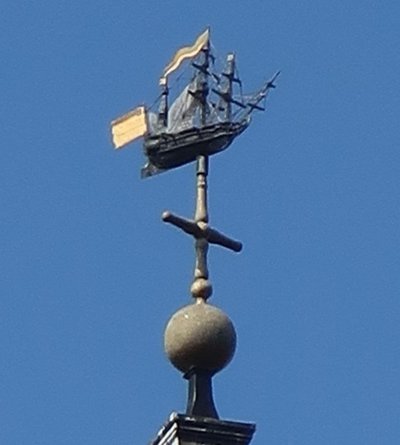
The weathervanes are a separate case, because several of them have moved. The three-master on St Nicholas Cole Abbey came from St Michael Queenhithe, a church demolished in 1876, and only arrived here when the bombed shell was rebuilt in 1962 — the Royal Commission's 1929 survey found Cole Abbey's own spire carrying nothing but a gilt ball and vane, which is still visible underneath the ship. When a City church came down its vane usually went to the parish it was united with, so a vane is not always evidence about the building under it.
Three stories that do not survive checking
The lampposts on the Mall are said to carry one ship for each vessel of Nelson's fleet at Trafalgar, with Nelson on his column turned to survey them. Neither half holds. The 44 bronze standards are Sir Aston Webb's, made in 1911 as part of the Queen Victoria Memorial scheme, and the listing describes each finial as a nef over a cypher — a nef being a ship-shaped ornament, a form with a long decorative history and no connection to any particular ship. No listing, and no record from the Royal Parks or Historic England, ties them to Nelson. And Nelson faces down Whitehall, not the Mall.
The gilded ship at 125 Pall Mall is said to sit above the premises where James Christie began auctioneering in 1767. The vane is real and the building is a good deal older than it looks — 1912 to 1913, by H. R. Houchin and Frank Smee, with a copper dome carrying an openwork globe. But Christie's first rooms, the ones recorded as 125 Pall Mall, were at an older numbering on the site of today's 116, and from 1768 he worked from 83 to 84 Pall Mall. The address is a coincidence of renumbering.
Lloyd's Register's carrack is said to stand on the site of the coffee house both Lloyd's institutions grew out of. It does not. Edward Lloyd's house was in Great Tower Street from 1688 and at 16 Lombard Street from 1691, about a third of a mile west of Fenchurch Street, and this frontage carried East and West India Company warehouses before Lloyd's Register bought it.
The entries
St Nicholas Cole Abbey
114 Queen Victoria Street EC4V 4BJ Nearest station: Mansion House
A three-masted ship in full rig, dark-hulled with gilded pennants, on the spire of Wren's church of 1671 to 1681. It is not the church's own vane: it came from St Michael Queenhithe, demolished in 1876, and was put up here when Arthur Bailey rebuilt the interior in 1962, twenty-one years after firebombs gutted it. Wren's gilt ball and cross-vane are still there, immediately below the ship. While the church was a shell it played the getaway scene in The Lavender Hill Mob, which the British Film Institute confirms was filmed here in 1951. Grade I. There is a coffee shop inside on weekdays, so the interior is free too. Why it is called Cole Abbey is genuinely unsettled: the earliest form is Sancti Nichi Coldabbei, usually read as Cold Abbey and linked to coldharbour, but Stow put it down to the exposed site and the London Gardens Trust says plainly that nobody knows.
The lamp standards on the Mall
The Mall SW1A 2BL Nearest station: Charing Cross
Forty-four cast-bronze standards line the road and the circus in front of the palace, each with dolphins at the corners of its base and, at the top, what the listing calls a nef over a cypher: a ship-shaped ornament above the royal monogram. They are Sir Aston Webb's, 1911, made as part of the processional scheme around the Queen Victoria Memorial, and they were listed Grade II in December 1987. The thirty-three cast-iron standards on the north side are plain, so it is worth checking which side of the road you are on.
Liberty
Great Marlborough Street W1B 5AH Nearest station: Oxford Circus
The Tudor Revival building of 1922 to 1924 by Edwin T. Hall and E. Stanley Hall is made of two broken-up warships. The listing says so in as many words: timber from HMS Hindustan and HMS Impregnable, more than 24,000 cubic feet of oak and teak, with the ships' decks laid as the shop flooring and the Great Marlborough Street frontage set to the length of the Hindustan. On the central gable is a gilded model of the Mayflower, four feet high, working as a weathervane. Grade II*. The frieze of a camel, an elephant and a ship carrying the wealth of distant countries to Britannia is a different building: the Regent Street block of 1925 to 1926, by the sculptors Charles Doman and Thomas J. Clapperton, joined to the Tudor building by a bridge.
Trinity Green almshouses
Mile End Road E1 4UN Nearest station: Stepney Green
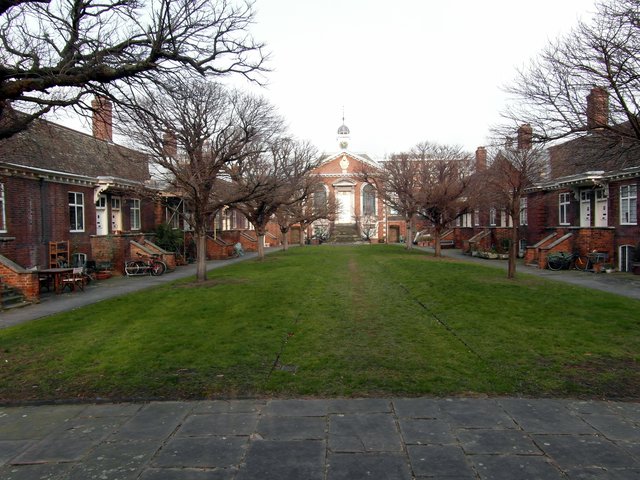
Two low brick terraces of 1695 facing each other across a green, with a chapel closing the view, built by the Corporation of Trinity House on ground given by Captain Henry Mudd of Ratcliffe. The inscription reads that the almshouse is where twenty-eight decayed masters and commanders of ships, or the widows of such, are maintained. Ships sit on the two blocks that front the road; the ones in place are reported to be fibreglass copies made when the London County Council restored the war damage in the 1950s, and the marble originals are said to have gone to the Museum of London, though that last part rests on a single second-hand account and the museum's catalogue does not list them. Grade I. Readable from the pavement; the green behind is gated.
St Olave Old Jewry
9A Ironmonger Lane EC2V 8EY Nearest station: Bank
Wren's church of 1670 to 1679 was closed in 1887 and pulled down the following year except for its tower and west wall, which now front a 1986 office building. The tower is the only one from Wren's office that is battered, wider at the bottom than the top, and it carries a rigged ship on its parapet. That vane is usually said to have come from St Mildred Poultry, whose parish was united with this one and which was demolished in 1872 — plausible, and repeated everywhere, but the Royal Commission described this parapet in detail in 1929 and recorded no vane on it at all, while noting the comparable ship at Queenhithe in the same volume. So either it was overlooked or the ship arrived later. Grade I, and the front garden is open.
Lloyd's Register
71 Fenchurch Street EC3M 4BS Nearest station: Aldgate
T. E. Collcutt's building of 1900, occupied in December 1901, with a copper-gilt carrack by Hardman and Company on the Fenchurch Street turret. There were originally two: a steamship vane crowned the turret on Lloyd's Avenue and did not survive building alterations in 1910. A plain steel vane based on the steamship Envoy was made for the dome in 2000, so of the three ships up there only the carrack is original fabric. Grade II*. The interiors, which are the real reason to care about this building, open for Open House.
St Olav's Norwegian Church
1 St Olav's Square, Albion Street SE16 7JB Nearest station: Canada Water
John L. Seaton Dahl's church of 1927, consecrated that June with Crown Prince Olav present, built for Norwegian seamen working the Surrey Docks. Through the Second World War it was the gathering point for Norwegians in exile: its reading room recorded something like 45,000 visits in 1940 alone, and King Haakon VII spoke here on the 17th of May 1941, Norway's constitution day. A Viking-ship weathervane is widely reported on the spire; the listing describes only a spire with a lantern, so treat the ship as local report, not record. Grade II. Still a Norwegian church, with a café a few days a week. Rotherhithe station is on the Overground, not the Underground.
Two Temple Place
Two Temple Place WC2R 3BD Nearest station: Temple
John Loughborough Pearson built this for William Waldorf Astor between 1892 and 1895 as the Astor Estate Office, with a flat for Astor himself, and every surface of it refers to somebody's voyage. On the roof ridge is a gilded weathervane in the form of the Santa María, the caravel Columbus sailed, made by J. Starkie Gardner and Company, who did all the metalwork inside and out. Grade II*. The vane reads from the Embankment. The inside is a private events venue that runs one free exhibition a year and opens for Open House, so check before travelling.
Ship House
20 Buckingham Gate SW1E 6LB Nearest station: St James's Park
A terrace house of 1895 by Sir Reginald Blomfield, Grade II*, with an ornamental metal ship fixed above the ground floor on the right. The listing records the ship and says nothing else about it: no date, no maker, no reason. The first occupant was a banker, not a shipowner. Pevsner noticed in 1952 that the name and the emblem must predate whoever was in the building and could not account for either, and the 2003 revision repeats the puzzle. It has been the High Commission of Eswatini, formerly Swaziland, for many years, and still is.
St Nicholas Flats, Somers Town
Aldenham Street NW1 1SP Nearest station: Euston
The strangest of them. Gilbert Bayes designed polychrome salt-glazed stoneware finials for the communal washing-line posts on this estate, made by Doulton and installed between 1931 and 1938 — a courtyard of sailing ships around a central finial, with more ships in his fairy-tale lunettes. They were not reliefs and they were not decoration for its own sake: the estate was built by the St Pancras House Improvement Society, founded in 1924 by the priest Basil Jellicoe after the slum clearances, on the argument that housing should be worth looking at. Every ship in place today is a copy. The originals were taken down in the 1980s and some later turned up at auction in the United States. They are not listed at any grade. This is estate land, so the sightlines are worth checking on foot before making a journey.
Bush House
30 Aldwych WC2B 4BG Nearest station: Temple
Built for Irving T. Bush as an international trade centre with exhibition galleries, by the New York firm Helmle and Corbett, the centre block opening on the 4th of July 1925 and the wings following until 1935. The ship connection is genuine twice over: Bush's fortune came from the Bush Terminal Company in Brooklyn, seven enclosed piers of shipping and warehousing, and the rear elevation to the Strand carries a stone carving of a ship crossing between America and Britain, flanked by statesmen of both. Malvina Hoffman's figures on the Aldwych portico have no catalogue title and are known by their inscription, to the friendship of English-speaking peoples. Grade II.
125 Pall Mall
125 Pall Mall SW1Y 5EA Nearest station: Charing Cross
An Eclectic Baroque office block of 1912 to 1913 by H. R. Houchin and Frank Smee, in Portland stone with a copper dome, closing the view up the Haymarket. On the dome is a finial with an openwork globe and, above it, a ship weathervane. Grade II. The story that James Christie auctioned here from 1767 belongs to a different building on an older numbering, and the tale of a dial in the offices below connected to the vane rests on a single self-hedging blog. The vane itself is worth the look up.
The bawley on Lovat Lane
Lovat Lane EC3 Nearest station: Monument
A fishing boat on a City rooftop, and a memorial. The plaque under it reads, in full: The weather vane above this tower represents a Bawley fishing boat. Whitebait were caught by this type of craft in the River Thames, until 1950. In memory of Gordon V. Young, 1904 - 1976, who knew Billingsgate Market well and built up the family business, W. Young & Son. A bawley is a Thames-estuary variant of the smack, worked for shrimp as much as whitebait, and the name probably comes from the boiler carried aboard to bawl — boil — the catch. Two things to be straight about: the building under it went up in 1985 and is not listed, and everything above is the plaque’s own wording rather than an institutional record. The claim that the family firm was Britain’s largest fish brand appears in one volunteer-run source and nowhere else, so it is not here.
The Helmsman
Pimlico Gardens, Grosvenor Road SW1V 3JY Nearest station: Pimlico
A small bronze by André Wallace, erected in 1996 at the west end of Pimlico Gardens: a stylised helmeted figure on a mass that suggests a boat's helm, raised on a slender pole. It is not, as often described, a figure at a wheel or a tiller. The plaque beneath records only that it was given by Berkeley Homes. The account that it won a competition between five artists judged by the Lord Mayor of Westminster with councillors and residents traces to one dead web page and cannot be confirmed from Historic England, the Public Statues and Sculpture Association or Westminster's own heritage statement, so it is left out here. Historic England, for what it is worth, records the sculptor as Andrew Wallace.
Questions
Do the ships on the Mall lampposts represent Nelson's fleet?
No. The forty-four bronze standards are Sir Aston Webb's, made in 1911 for the processional scheme around the Queen Victoria Memorial, and the listing calls each finial a nef over a cypher. Nothing in the listing or in Historic England's record connects them to Nelson or to Trafalgar. Nelson, on his column, faces down Whitehall.
Is Liberty really built out of warships?
Yes, and it is in the listing rather than in folklore: timber from HMS Hindustan and HMS Impregnable, both early nineteenth-century sailing men-of-war, more than 24,000 cubic feet of it, with the ships' own decks used as the shop floors.
Why do City churches carry ship weathervanes instead of cockerels?
Usually because of the dedication. St Nicholas is the patron saint of sailors and St Olav was a Norwegian king, so those churches reach for the sea. But several of the ships are also migrants: when a City church was demolished its vane commonly went to the parish it had been united with, which is how a three-master from St Michael Queenhithe ended up on St Nicholas Cole Abbey.
Did a pope order every church to be topped with a cockerel?
There is no such decree. Nobody who repeats the story can produce a text, canon or register entry, and the trail runs back to a popular book of 1953 rather than to the ninth century. What is documented is a devotional tradition: Gregory I thought the cock the most suitable emblem of Christianity because it was St Peter's, and Leo IV had a weathercock put on Old St Peter's. The oldest weathercock that survives, the Gallo di Ramperto in Brescia, was made around 820 to 830 — before the pope the edict is usually attributed to.
Did Wren design a different weathervane for each of his churches?
Not as far as any record shows. Wren is not documented as designing weathervanes at all. Several are plain arrow-and-pennant, several came from other churches, several are later replacements, and some of his churches never had one. St Mary-le-Bow's dragon was modelled in wood by Edward Pierce for four pounds and made in copper by Robert Bird for thirty-eight: carvers' and coppersmiths' work. What is true is that the spires were all different.
Which of these can be seen without paying or going inside?
All thirteen. Everything on this page is on an exterior, readable from a public pavement or a public garden. Two have free interiors as well: there is a coffee shop inside St Nicholas Cole Abbey on weekdays, and St Olav's opens for services and a café. Trinity Green's inner green is gated and the Somers Town posts stand on estate land, so those two are worth a look on a map first.
Elsewhere on this site: guide to London statues, statues of workers.