Piccadilly Circus
why the lights are on one side only, who the statue actually is, and what to look for at street level
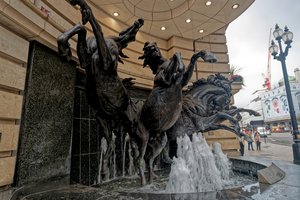
Piccadilly Circus is the most photographed junction in London and almost nothing about it is what people assume. The advertising is on one building because the Crown owns the other three. The statue everybody calls Eros is not Eros. And the best sculpture on the site is a group of horses at the Haymarket corner that most of the crowd has its back to.
Why the lights are on one side
Three sides of the circus are leased from the Crown Estate, and those leases prohibit illuminated advertising. The fourth side was in different ownership with looser terms, so the signs went up there in the early twentieth century and have stayed there ever since.
That is the whole explanation for a view that appears on postcards worldwide: a difference in the terms of a lease. The single curved screen that replaced the separate signs in 2017 keeps the arrangement, on the same building.
Leicester Square, two minutes away
Coventry Street runs east from the circus to Leicester Square, which is about a two-minute walk and is the other half of most visits. The square has its own small collection: a Shakespeare fountain of 1874 at the centre, a seated Charlie Chaplin of 1981 near the north-west corner, and busts of Hogarth, Reynolds, Newton and John Hunter, all four of whom lived on the square.
The two spaces are usually walked as one and read as one, and the difference between them is worth noticing: Piccadilly Circus is a road junction that acquired a crowd, and Leicester Square is a garden that acquired one.
The entries
The Shaftesbury Memorial
Piccadilly Circus W1 Nearest station: Piccadilly Circus
The winged figure on the fountain is Anteros, the god of selfless love, put up in 1893 to commemorate the philanthropist Lord Shaftesbury and made by Alfred Gilbert. It was one of the first statues anywhere cast in aluminium. It is universally called Eros, which is the wrong brother.
The Horses of Helios
Haymarket corner W1 Nearest station: Piccadilly Circus
Rudy Weller's 1992 bronze group at the Haymarket corner, four horses apparently bursting out of the pavement, with three female figures diving from the roof of the same building above. The best sculpture on the site and the one most of the crowd faces away from.
Piccadilly Circus station
Beneath the circus W1 Nearest station: Piccadilly Circus
One of the few Underground stations with no building above ground at all: the booking hall of 1928 is entirely below the pavement, designed by Charles Holden, Grade II listed, and handles tens of millions of journeys a year.
The police public call post
Piccadilly Circus, west of the Regent Street junction W1 Nearest station: Piccadilly Circus
Everyone calls it a disused police phone box, and it is not a box: it is a cast-iron post, about waist height, on the pavement just west of where Piccadilly meets Regent Street, with POLICE and POLICE PUBLIC CALL POST lettered in white on blue and a crown on top. Historic England dates it to about 1935 or earlier, names the Carron Foundry as its maker, calls it a rare survival and listed it Grade II in 1988. Its instruction plate is broken. Britain's first public police telephones went up in Glasgow in 1891, hexagonal and painted red, and the usual claim that the 999 service killed them off in the late 1930s is wrong by about thirty years: boxes and posts stayed central to policing until personal radios reached the beat in the late 1960s and 1970s.
The Three Graces
Coventry Street corner, Piccadilly Circus W1 Nearest station: Piccadilly Circus
Almost everybody photographs the horses in the fountain and almost nobody looks up at the other half of the same commission. Three female figures dive head-first from the roof above, at the Coventry Street corner, by Rudy Weller and of 1992, the same sculptor and the same year as the horses below. Pevsner records Peter Howard of Renton Howard Wood Levine as the architect of the building they are attached to. They are mounted on curved dark rails at sixth-floor roof level on the Criterion building and were photographed there in December 2024, so they are still up. They are often called the Daughters of Helios, which pairs them neatly with the horses but is not a name traceable to the sculptor, and no source gives their material, so the bronze usually claimed for them is a guess. Neither group is listed.
The Criterion
224 Piccadilly W1J 9HP Nearest station: Piccadilly Circus
Behind a gold-mosaic ceiling on the south side is the only Victorian entertainment complex in London that survives whole: a restaurant opened by the caterers Spiers and Pond on the 17th of November 1873 to Thomas Verity's design, with a theatre buried in the basement the following year. Grade II* listed. It is also where Conan Doyle put Watson at the moment the whole thing starts: I was standing at the Criterion Bar, when some one tapped me on the shoulder — A Study in Scarlet, and a plaque has marked it since 1953. Be clear about what is there now: the historic Criterion Restaurant closed in 2015, and the room has held Masala Zone since 2023. The theatre is unaffected and still working.
Lillywhites
24-36 Lower Regent Street SW1Y 4QF Nearest station: Piccadilly Circus
A sports shop since 1863, founded in the Haymarket by the Lillywhite cricketing family and at this corner since 1925, in a Portland stone block of about 1910 to 1920 by Sir Reginald Blomfield on a steel frame, Grade II. The cricket story attached to it is usually told the wrong way round. Frederick William Lillywhite was the great champion of roundarm bowling, legalised in 1835, not of overarm. Overarm was legalised in 1864 after Edgar Willsher was no-balled six times at the Oval in August 1862 — by the umpire John Lillywhite, William's son. And James Lillywhite junior, who captained England in the first Test at Melbourne in March 1877, was William's nephew, not his son. The tour bore his name; whether he paid for it is not something any source will confirm.
The Trocadero
Shaftesbury Avenue W1 Nearest station: Piccadilly Circus
Opened by J. Lyons and Co. in 1896 as London's most fashionable dining rooms, the first public restaurant in the city with a wine cellar. It has been a restaurant, an amusement arcade and a shopping centre, and is now partly a hotel.
Questions
Is the statue Eros?
No. It is Anteros, Eros's brother, the god of requited and selfless love, which was the point: the memorial honours Lord Shaftesbury's philanthropy. The sculptor Alfred Gilbert was explicit about it. The wrong name won anyway and has been in general use for over a century.
Why is the advertising only on one building?
Because the Crown Estate holds the leases on three sides of the circus and those leases forbid illuminated signs. The fourth side had looser terms when advertising arrived, and that is where it went. The 2017 single-screen replacement is on the same building for the same reason.
What are the horses at the corner?
The Horses of Helios, a 1992 bronze by Rudy Weller, showing the horses of the sun god breaking out of the pavement at the Haymarket junction. Three diving female figures by the same sculptor are on the roof of the building above, and almost nobody looks up at them.
Is the statue really made of aluminium?
Yes, and it was among the earliest public statues anywhere cast in the metal, which was still close to a novelty in 1893. That is also why it is much lighter than it looks and why it has needed careful repair after repeated damage from crowds and traffic.
Elsewhere on this site: guide to London statues, horses in London sculpture.